19 min read
 Article Summary
Article Summary- A B2B demand generation strategy has one job: turning buying intent into qualified pipeline, not form fills. It runs on four layers: create demand with buyers who aren’t in market yet, capture it when they are, convert it inside target accounts, and prove the pipeline to finance.
- Most of your market isn’t buying right now. Only about 5% of B2B buyers are in market in a given quarter (Ehrenberg-Bass Institute for the LinkedIn B2B Institute, 2021). Buyers then choose from their day-one shortlist 95% of the time (6sense, 2025 B2B Buyer Experience Report). Capture budgets compete for a small, crowded pool. Creation decides whether you’re on the shortlist before the cycle starts.
- Each paid channel has its own job. Google Search captures buyers who are already researching, so more budget won’t help if impressions are flat. LinkedIn is the backbone of creation and ABM, so judge it on target-account reach, not cost per lead.
- ABM is the convert layer pointed at a named account list, not a separate strategy. Start with a short Tier 1 list that sales agrees on. Nearly half of ABM programs still judge success by MQLs (6sense, 2025), which pulls them back into lead generation.
- Measure qualified pipeline created, not MQL volume. Back it with pipeline sourced and influenced, win rate by source, CAC payback, and a required “How did you hear about us?” field on forms. That field reveals the AI-assistant and peer influence that software attribution misses.
- With budgets flat at 7.8% of revenue (Gartner, 2026 CMO Spend Survey), how the budget is split matters more than its size. The 90-day plan has three phases: audit and agree definitions, rebuild paid media by layer, then review pipeline with finance and reallocate. Creation-layer results take two to three quarters to show.
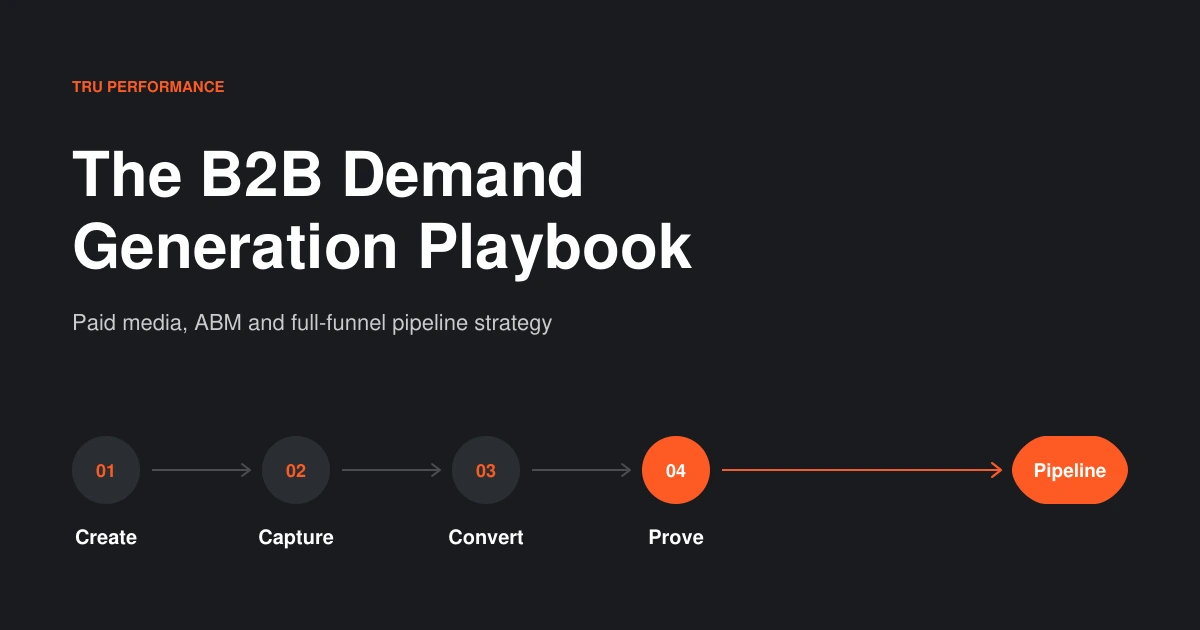
A B2B demand generation strategy is the system that creates buying intent, captures it when it surfaces, and turns it into qualified pipeline instead of form fills. It runs on four layers: create demand with buyers who are not in market yet, capture it when they are, convert it inside target accounts, and prove the pipeline to finance. This playbook covers channel roles, ABM, budget splits, measurement and a 90-day rollout for B2B SaaS and enterprise teams.
What is a B2B demand generation strategy?
A B2B demand generation strategy is the plan for how a company builds awareness and preference with its future buyers, captures that intent when they enter a buying cycle, and converts it into qualified pipeline that sales can close. It covers the whole path, from the first time a buyer hears your name to the opportunity sitting in your CRM.
The word that matters is strategy. Most B2B teams already run the tactics: LinkedIn ads, a quarterly webinar, a paid search budget, an ebook behind a form. What they lack is the system that decides which activity does which job, how much each gets, and how anyone will know it worked.
It is:
- A system with distinct layers, each with its own job and its own metric
- A budget decision about how much to spend reaching people who are not buying yet versus people who are
- A shared definition of pipeline that marketing, sales and finance all sign
It isn’t:
- A lead generation program with a new name. Lead gen counts contacts; demand gen counts pipeline.
- A channel plan. “We run LinkedIn and Google” describes where the money goes, not why.
- A campaign. Campaigns end. The engine underneath them runs all year.
Demand generation vs lead generation
Lead generation trades content for contact details and hands those contacts to sales. It is measurable and fast, which is why it dominated B2B marketing for a decade. The problem: most of those contacts were never going to buy, and the ones who were would have found you anyway.
Demand generation keeps lead capture as one tool but stops treating it as the goal. It invests in reaching the right accounts before they are in market, so that when a buying cycle starts, your company is already on the shortlist. The output it is judged on is qualified pipeline and revenue, not the number of PDFs downloaded.
The numbers that change how you plan
Four findings shape every demand generation plan we build. Each one changes where the budget should go.
- Only about 5% of B2B buyers are in market in any given quarter, and about 20% across a full year. The rest will not buy from anyone until a contract, budget or problem changes (Ehrenberg-Bass Institute for the LinkedIn B2B Institute, 2021). It is a rule of thumb from purchase-cycle research, not a precise count, but it is the right default for planning.
- Buyers choose from their day-one shortlist 95% of the time. They now make first contact with sellers about 61% of the way through their journey, earlier than the 69% a year before but still well after the shortlist is set (6sense, 2025 B2B Buyer Experience Report, November 2025).
- The average buying decision involves 13 internal stakeholders and nine external participants (Forrester, The State of Business Buying, 2026, January 2026). You are not persuading one buyer. You are building consensus across a committee.
- 94% of business buyers now use AI during their buying process (Forrester, The State of Business Buying, 2026, January 2026), and 51% of B2B software buyers start research in an AI chatbot more often than in Google (G2, The Answer Economy, April 2026).
Put together: most of your market is not buying this quarter, the buyers who are have formed a view before they talk to you, and they increasingly form it inside AI assistants you cannot track. A strategy built only to harvest form fills aims at the smallest, most contested part of the market.
Demand creation vs demand capture
Demand creation reaches buyers before they are in market. Demand capture is how you win the ones who already are. A working B2B demand generation strategy funds both, and treats them as separate jobs with separate scorecards.
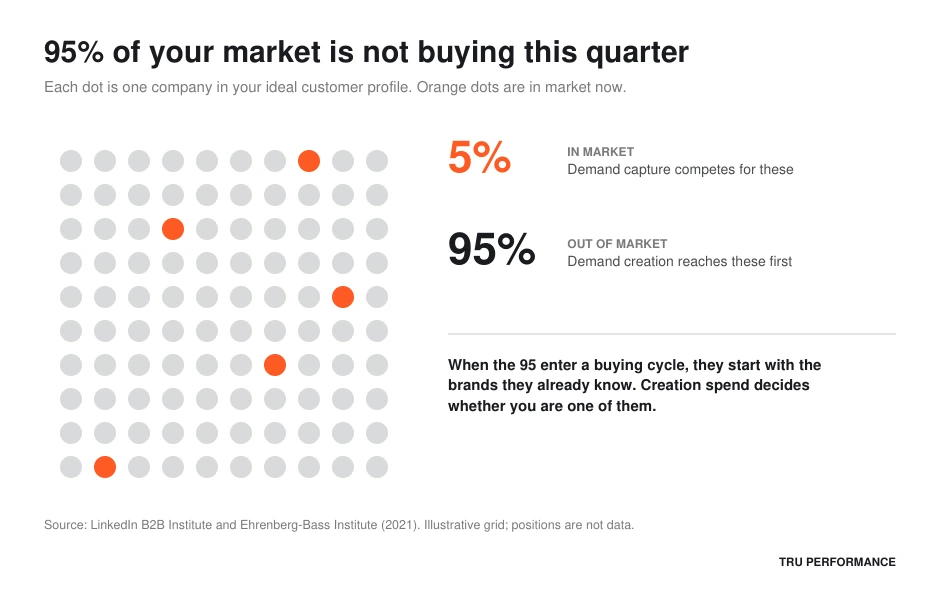
Capture is where most B2B budgets start, and for good reason. High-intent search, review sites and retargeting reach people who are actively looking, and the cost per opportunity is easy to calculate. The ceiling is that you are bidding for a small group of in-market buyers against every competitor who can afford the same keywords.
Creation works on a longer clock. LinkedIn thought-leadership ads, original research, executive content and video put your point of view in front of the accounts you want, months before they open a buying cycle. You cannot attribute a closed deal to one post, which is why finance teams are skeptical of creation budgets. They are right to ask for proof; they are wrong if they conclude the spend does nothing. The proof comes from leading indicators like branded search, direct traffic from target accounts and the share of new opportunities that name you as already known.
| Demand creation | Demand capture | Account-based marketing (ABM) | |
|---|---|---|---|
| Who it reaches | The full ICP, mostly out of market | Buyers actively researching now | A named list of target accounts |
| Typical channels | LinkedIn thought-leadership ads, research, video, podcasts, executive content | Google Search, review sites, retargeting, comparison pages | Personalized ads, direct outreach, sales plays, events |
| Time to impact | 2–3 quarters | Weeks | 1–2 quarters per account tier |
| Primary metric | ICP reach, branded search growth, share of search | Cost per qualified opportunity | Meetings with the buying group, pipeline per account |
| Failure mode | Judged on last-click leads and cut too early | Bidding up a small in-market pool | Too many accounts, too little personalization |
The demand engine: four layers, one pipeline number
Every effective B2B demand generation strategy we have run comes down to four layers. The names are less important than the discipline: each layer has one job, one metric, and one owner.
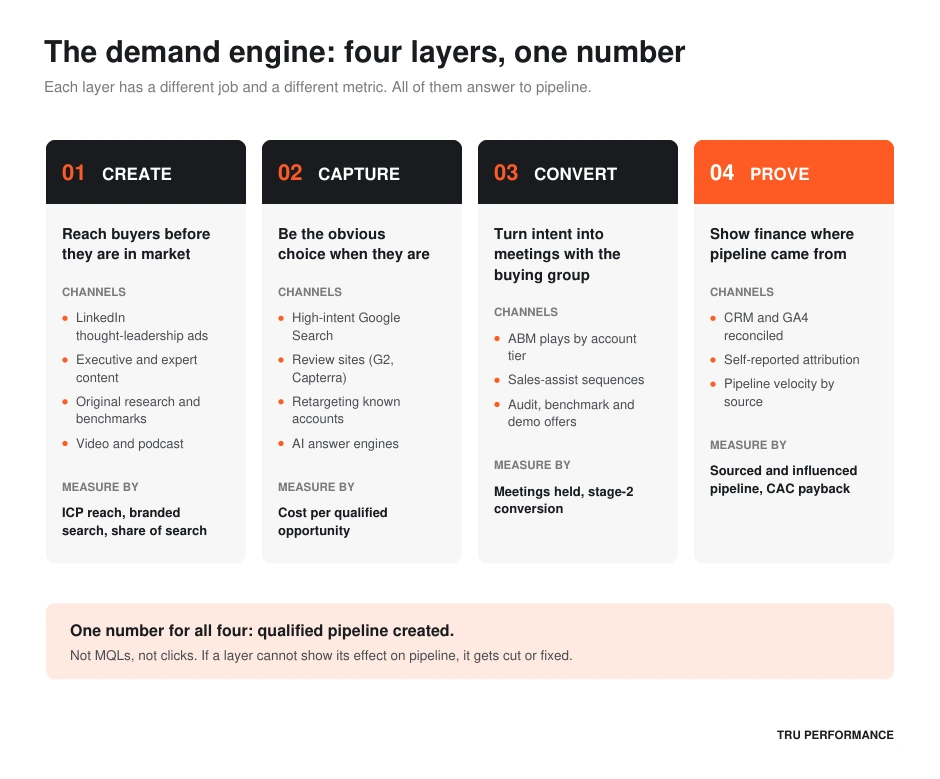
1. Create: reach buyers before they are in market
The creation layer exists to make the right accounts know who you are and what you believe before they need you. That means a clear point of view, repeated often, in the places your buyers spend time. For most B2B SaaS and enterprise categories, that is LinkedIn first, followed by industry newsletters, podcasts and events.
The content that works here is not gated. Original data, frameworks a practitioner can use on Monday, and executive commentary on how the category is changing all earn attention without asking for an email address. Gating your best thinking in this layer shrinks its reach to the small group willing to fill in a form.
2. Capture: be the obvious choice when they are in market
When an account enters a buying cycle, its people search, read reviews, ask peers and, increasingly, ask AI assistants for a shortlist. The capture layer makes sure you show up in every one of those moments with a page that answers the question they actually asked.
High-intent paid search, a well-maintained review site profile, retargeting of known accounts and comparison pages do most of the work. So does being cited in AI answers, which now sits squarely in this layer. Our guide to generative engine optimization covers how B2B brands earn those citations.
3. Convert: turn intent into meetings with the buying group
Intent is not pipeline until someone from the buying group agrees to a conversation. The convert layer covers the offers, sales plays and ABM programs that move an engaged account to a meeting. An audit, a benchmark review or a working session on the buyer’s own data converts better than a generic demo request, because it gives the buying group something they can take to their boss.
This is also where marketing and sales either work as one team or fall apart. Shared account lists, agreed definitions of a qualified opportunity, and a service-level agreement on how fast sales follows up matter more here than any single channel.
4. Prove: show finance where pipeline came from
The prove layer is the one most teams skip, and the reason demand generation budgets get cut. It reconciles CRM and analytics data, adds self-reported attribution to software attribution, and reports pipeline in a way finance recognizes. If you cannot explain your number to a CFO, you will lose the budget argument no matter how good the campaigns were.
We have written separately about why last-touch attribution hides most of your pipeline and how to build an attribution model your CFO will trust. Both sit underneath this layer.
B2B paid media: what each channel is actually for
B2B paid media fails most often when every channel is asked to do the same job: produce leads at a target cost. Each channel has a natural role in the engine. Plan around those roles and the targets start to make sense.
| Channel | Job in the engine | Buyer state | Metric that matters | Common mistake |
|---|---|---|---|---|
| LinkedIn Ads | Create and convert | Out of market to early research | Engaged reach in ICP accounts, meetings from target accounts | Running only lead-gen forms and judging on cost per lead |
| Google Search | Capture | Actively researching | Cost per qualified opportunity | Bidding on broad category terms with no exclusions |
| Review sites (G2, Capterra) | Capture | Shortlisting | Profile views from ICP accounts, review-assisted pipeline | Treating the profile as set-and-forget |
| Retargeting and programmatic | Capture and convert | Known accounts, mid-cycle | Return visits and meetings from engaged accounts | Retargeting everyone, including students and competitors |
| YouTube and connected TV | Create | Out of market | Branded search lift, view-through to target accounts | Using direct-response creative on a brand channel |
| Meta (Facebook, Instagram) | Convert (retargeting only, for most B2B) | Known visitors | Cost per return visit from known accounts | Prospecting cold B2B audiences without firmographic data |
Two practical notes. First, search is a capture channel, so its volume is capped by how many people already know they have the problem. If search impressions are flat, more search budget will not fix it; more creation will. Our post on PPC strategies for SaaS growth covers the search side in detail, and Google Ads auction insights shows how to read the competitive pressure on your terms.
Second, LinkedIn is the only major channel where you can target by company, job title and seniority with confidence. That makes it the backbone of both creation and ABM for most B2B companies, and the reason it costs more per click. Judge it on what it does for target accounts, not on cost per lead. Dreamdata’s 2026 LinkedIn Ads Benchmarks Report, built on its own customers’ attribution data, shows why: LinkedIn’s cost per click was €5.98, but its cost per company influenced was €70.11, below Google Search at €110.37 (March 2026).
Where ABM fits in a demand generation strategy
ABM is not a separate strategy. It is the convert layer pointed at a named list of accounts. It works best when the creation layer has already warmed those accounts, and worst when it is used to cold-call companies that have never heard of you.
ABM is now mainstream, but its scorecards have not caught up. Nearly 80% of organizations run an ABM program, yet only 29% of ABM teams are measured solely on ABM-aligned metrics, and nearly half still judge success by MQLs (6sense, State of B2B Marketing Metrics, 2025). An account program measured on lead volume will drift back into lead generation.
Most mid-market teams run ABM in three tiers:
- Tier 1 (one-to-one): 10 to 25 strategic accounts, each with a tailored plan, personalized content and a named sales and marketing pair. Highest cost per account, longest cycle, biggest deals.
- Tier 2 (one-to-few): 50 to 200 accounts grouped by industry or use case, with content and ads built for each cluster.
- Tier 3 (one-to-many): a few hundred to a few thousand accounts reached through firmographic ad targeting and intent signals, with lighter personalization.
The most common mistake is starting with a list that is too long. An ABM program with 2,000 “target” accounts and no extra personalization is just account-filtered advertising. Start with fewer accounts, agree with sales on why each one is on the list, and expand once you can show meetings and pipeline from the first tier.
How to split a B2B demand generation budget
There is no universal split, but there is good evidence for where to start. Analysis of IPA effectiveness data by Les Binet and Peter Field for the LinkedIn B2B Institute found that B2B brands grow best when roughly 46% of the budget goes to brand-building and 54% to activation (The Five Principles of Growth in B2B Marketing, 2019). In the engine’s terms, brand-building is the create layer and activation is capture plus convert.
The total is not about to rescue a weak split. Marketing budgets sit at 7.8% of company revenue in 2026, barely up from 7.7% in 2025, and 56% of CMOs say they lack the budget to deliver their 2026 strategy (Gartner, 2026 CMO Spend Survey, May 2026). With flat budgets, where the money goes matters more than how much there is.
The allocation below is the starting point we use with clients before adjusting for category, deal size and sales motion. It is a planning default from our own engagements, not an industry benchmark.
| Company stage | Create | Capture | Convert (incl. ABM) | Prove (data, tools, reporting) |
|---|---|---|---|---|
| Early scale ($5M–$20M ARR) | 30% | 45% | 15% | 10% |
| Mid-market ($20M–$100M ARR) | 40% | 30% | 20% | 10% |
| Enterprise (large, multi-product) | 45% | 25% | 20% | 10% |
Three rules sit on top of whatever split you choose:
- Protect the creation budget for at least two quarters. It will look unproductive on a last-click report for the first few months. Cutting it in month three guarantees the pipeline problem six months later.
- Cap capture spend at the point where cost per qualified opportunity starts rising sharply. That is the signal you have exhausted the in-market pool and are now paying more for the same buyers.
- Fund measurement before you scale. If you cannot reconcile pipeline by source, a bigger budget just produces a bigger argument.
Measuring demand generation: pipeline, not MQLs
The single number a B2B demand generation strategy should answer to is qualified pipeline created. Every other metric is either a leading indicator of that number or a diagnostic for why it moved.
The scorecard we use has three tiers:
- Lagging (quarterly): qualified pipeline created, pipeline sourced and influenced by marketing, win rate by source, CAC payback period.
- Leading (monthly): meetings with buying-group members at target accounts, branded search volume, direct traffic from ICP accounts, share of new opportunities that self-report hearing about you before they searched.
- Diagnostic (weekly): channel-level cost per qualified opportunity, engaged reach in target accounts, conversion rate from meeting to stage-two opportunity.
Self-reported attribution deserves its own line. Adding a required, open-text “How did you hear about us?” field to demo and contact forms regularly surfaces podcasts, LinkedIn posts, peer recommendations and AI assistants that software attribution never sees. It does not replace your CRM data. It explains the gap between what the CRM credits and what buyers say happened.
MQL volume is missing from the list on purpose. It is easy to inflate, it rewards gating content that should be free, and it tells you nothing about whether the right accounts are entering pipeline. If your board still asks for MQLs, report them, but do not run the program on them.
Demand generation in the age of AI search
AI is now a research layer in almost every B2B purchase, and buyers treat it as a starting point rather than the final word. Gartner found that 69% of B2B buyers prefer to validate AI-generated insights with a sales rep (May 2026), and TrustRadius’s 2026 B2B Buying Disconnect Report found that 94% of buyers who used AI fact-checked its answers (July 2026). Buyers use AI to build the shortlist, then look for human sources to confirm it.
That changes two things in the engine. In the capture layer, being cited in AI answers becomes as important as ranking in search results, which rewards clear, specific, well-sourced content over keyword-stuffed landing pages. In the prove layer, it creates another blind spot: a buyer who shortlisted you inside ChatGPT shows up in your analytics as direct traffic, if at all. Self-reported attribution is how you see it.
It also changes what good creation content looks like. AI assistants summarize the category’s consensus, so content that repeats the consensus disappears into the summary. A distinct point of view, original data and named practitioners give the models something worth citing. The same operating shift is reshaping marketing teams more broadly, which we cover in our guide to AI-powered marketing operations.
In-house, agency or embedded partner?
Most growth-stage B2B companies run some mix of in-house and outside help. The right mix depends less on cost than on which layers you can staff with real expertise.
| Model | Works best when | Watch out for |
|---|---|---|
| Fully in-house | You have senior people in paid media, content, ops and analytics, and the volume to keep them busy | Gaps in specialist skills (programmatic, ABM orchestration, attribution) that one generalist cannot cover |
| Specialist agencies by channel | You need depth in one channel fast | Four agencies optimizing four channels to four different metrics, with nobody owning pipeline |
| One embedded partner across layers | You want one team accountable for the whole engine, working inside your stack and your pipeline definitions | Choosing a partner that cannot show pipeline results, only channel metrics |
The coordination cost of running several vendors is real and rarely budgeted. We break it down in the hidden cost of running operations across multiple vendors. The same build-versus-buy logic applies to search, which we cover in in-house SEO team vs agency.
Next step. Want a second opinion on where your pipeline is leaking? We will review your channel mix, budget split and measurement setup in a 30-minute pipeline review and show you the two or three changes with the biggest impact.
The 90-day plan to rebuild your demand engine
You do not need to rebuild everything at once. This is the sequence we run with new clients.
Days 1–30: audit and agree
- Pipeline audit. Pull 12 months of opportunities and map each one to its first known touch, its self-reported source and its account tier. Find out where pipeline actually comes from today.
- Definitions. Agree with sales and finance on what counts as a qualified opportunity, and what “sourced” and “influenced” mean. Write it down.
- Account list. Build or clean the ICP account list and pick the first ABM tier: 25 to 50 accounts sales agrees are worth the effort.
Days 31–60: rebuild the layers
- Restructure paid media by layer. Split campaigns into create, capture and convert, each with its own budget line and metric, instead of one blended cost-per-lead target.
- Launch creation content. Ship an ungated point-of-view series on LinkedIn, backed by one piece of original data or a practical framework.
- Add self-reported attribution. Put a required “How did you hear about us?” field on every demo and contact form, and start tagging responses weekly.
Days 61–90: measure and adjust
- First pipeline review. Report qualified pipeline by layer and source, including the self-reported view next to the CRM view.
- Reallocate. Move budget out of capture campaigns where cost per qualified opportunity is climbing and into creation or the first ABM tier.
- Lock the cadence. Set a monthly leading-indicator review and a quarterly pipeline review with finance in the room.
By day 90 you will not see the full effect of the creation layer; that takes two or three quarters. You will have a clean baseline, a budget organized by job instead of channel, and measurement finance can read.
What to read next
- Why last-touch attribution hides most of your pipeline: the measurement problem underneath every demand generation budget debate
- Building a B2B attribution model your CFO will trust: how to make the prove layer stand up in a finance review
- Why fewer martech tools produce more pipeline: the stack decisions that make demand generation easier to run
- AI-powered marketing operations: the operating model that ties the engine together
If you want a team that runs the whole engine with you, from creation through to the pipeline report, book a pipeline review and we will start with the audit.