10 min read
 Article Summary
Article Summary- Last-touch attribution credits only the final tracked click, the moment a buyer chose to become visible, not the months of research that decided the deal.
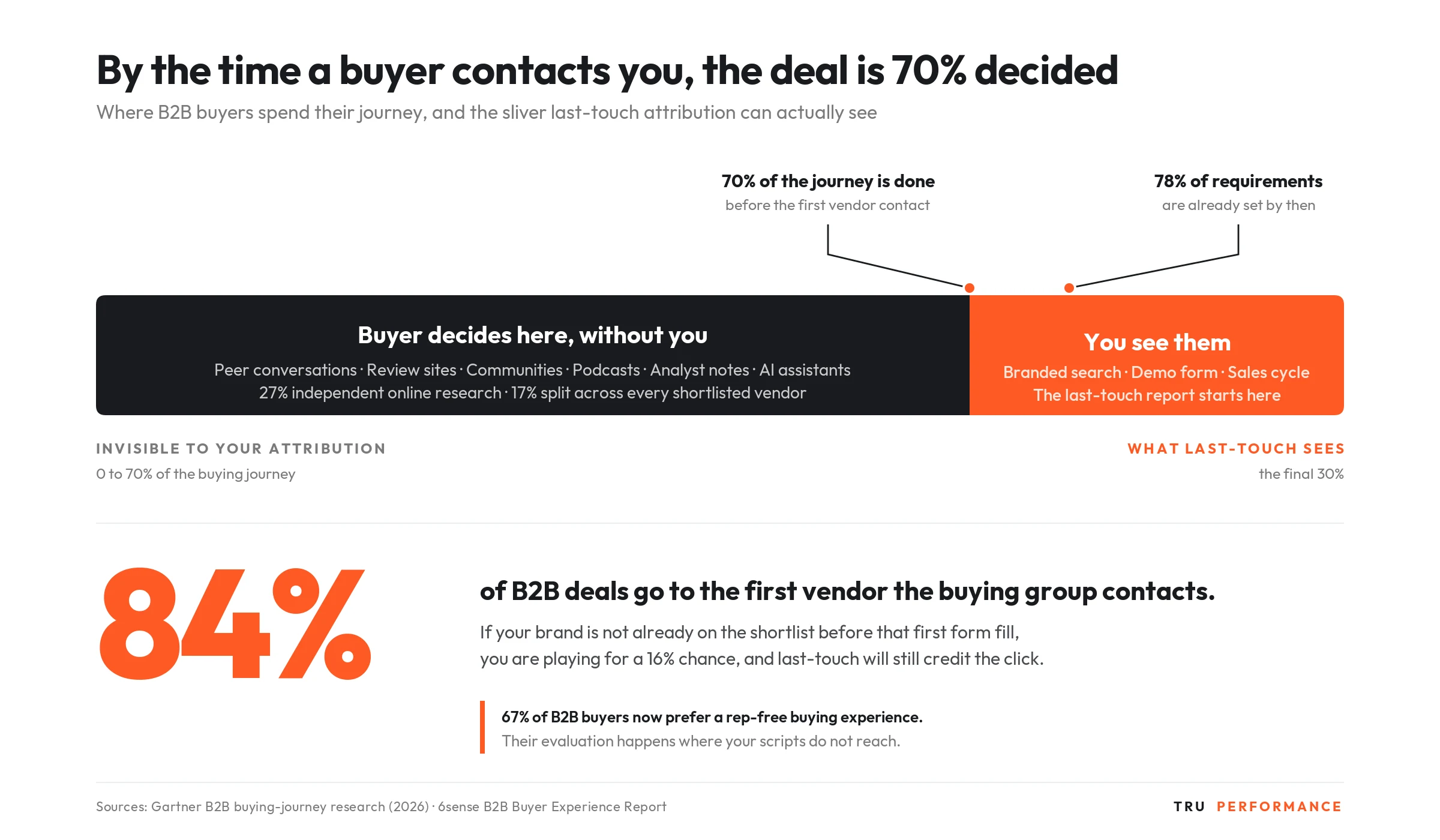
- Gartner’s B2B buying-journey research finds buyers spend just 17% of the purchase with suppliers and 27% researching independently online, and 67% now prefer a rep-free buying experience (Gartner, 2026).
- 6sense finds buyers make contact about 70% of the way through the journey, 78% have their requirements set by then, and 84% of deals go to the first vendor contacted.
- Budgets steered by last-touch quietly defund demand creation and over-fund demand capture, and the pipeline decline lands two or three quarters later, with no line on the dashboard to explain it.
- The fix is not a different attribution model. It is a four-layer blended readout, software attribution, self-reported attribution, account-level signals and incrementality, reconciled on one page each month.
Your attribution dashboard tells a clean story. A buyer searched your brand, clicked a result, filled the demo form and became pipeline. The report credits that final click, the budget review nods along, and every channel that did the earlier work gets nothing. The story is accurate about the last step and silent about everything before it. For most B2B purchases, everything before it is where the deal was decided.
That silence has a price, and it lands on the number you defend to the board. When the model can only see the final click, budget flows to whatever sits closest to it, and the work that actually created the demand is the first thing cut.
What last-touch attribution records
Last-touch attribution assigns 100% of the credit for a conversion to the final tracked interaction before the form fill. It is easy to implement, easy to read and consistent month to month, which is why it survives in so many reporting stacks. Its limit is just as plain: it records the moment a buyer chose to become visible, not the months of research that produced that moment.
A tracking script can only log activity on properties you control, from an identified browser, after consent. Peer recommendations, review-site reading, community threads, podcast mentions, analyst notes and months of anonymous visits all sit outside that window. When those influences finally push a buyer to your site, the model hands their combined weight to whichever channel happened to carry the final click. Branded search collects credit it never earned, and the work that created the demand is filed under nothing at all.
It is also why your analytics platform quietly over-reports “Direct / none.” When the gaps between sessions run into weeks or months, as they do across a six-to-twelve-month B2B cycle, the tool loses the original source and books the conversion as direct. The dashboard looks precise. It is precise about the wrong moment.
Buyers decide where your tools can’t see
Gartner’s research on the B2B buying journey found that buyers spend only 17% of the entire purchase meeting with potential suppliers, and 27% researching independently online. Split that 17% across the three or four vendors on a shortlist and any single sales team gets roughly 5–6% of the buyer’s attention. The buyer is working hard through all of it. Almost none of that work happens where your measurement can see it.
The preference behind the behaviour is hardening. In Gartner’s most recent sales survey, 67% of B2B buyers said they prefer a rep-free buying experience, up from 61% a year earlier, and 45% said they used AI tools during a recent purchase (Gartner, 2026). Buyers are deliberately evaluating on their own terms, in places your scripts do not reach, and increasingly through AI assistants that hand you no referrer at all.
The shortlist is set before the form
6sense’s B2B Buyer Experience Report reaches the same conclusion from the other side of the table. Buyers make direct contact with a vendor only about 70% of the way through the journey; by then, 78% have mostly or completely established their requirements. And 84% of deals go to the first vendor the buying group contacts.
Read those figures next to your attribution report and the problem sharpens. The demo request last-touch credits to a branded click was not the start of the deal. It was the closing formality of an evaluation you never observed, one your content, your customer proof and your presence in the buyer’s world either shaped or forfeited months earlier. If you were not on the shortlist before first contact, 6sense’s data says you were playing for a 16% chance.
What the blind spot does to your budget
Attribution reports exist to guide allocation, and this is where the distortion compounds. Last-touch rewards the channels that harvest existing demand, branded search and retargeting, because they sit closest to the form. It discounts the channels that create demand: thought leadership, PR, community, original research, the editorial that puts you on the shortlist in the first place. A CMO who reallocates strictly by the report shifts money toward harvesting and away from creation.
The trap is that the report then appears to validate the decision. Harvest channels look even stronger for a quarter or two, because demand created earlier is still flowing through them. The decline arrives later, as fewer buyers enter new cycles with your brand already shortlisted, and by then the dashboard offers no explanation, because the cause was never on it. This is not a rounding error. When you ask buyers directly, self-reported attribution routinely surfaces that 30–50% of pipeline originates from channels digital attribution cannot see (ORM, 2026). Teams that understand the sequence protect demand creation through the lag instead of cutting it at the first soft quarter.
What this means for your board report
The hardest part of this is internal, not technical. A board trained on last-touch dashboards will read any move away from them as marketing asking for softer accountability, so the reframe has to arrive with more rigour, not less. The honest position is simple to state: last-touch is a precise measurement of a small window, and that window sits at the end of a process Gartner and 6sense have both shown is largely finished before it opens. A precise number about the wrong window is not accountability. Committing to a blended readout, software attribution, buyer-reported sources, account-level signals and incrementality tests shown together and reconciled openly, is a higher standard of proof than the single-model dashboard it replaces. CMOs who make that case with the research in hand tend to win it.
The four-layer blended pipeline readout
No single model sees the whole journey, because every software model depends on tracked touches, and the touches that decide B2B deals are the ones that never get tracked. The durable answer is to stop asking one model to do a job it cannot do, and to read four layers together. Each answers a question the others cannot.
| Layer | What it sees | What it misses | The instrument |
|---|---|---|---|
| 1. Software (multi-touch) attribution | Every tracked touch inside your CRM and automation platform, in order | Anything anonymous, offline or word-of-mouth; over-credits the last click | A multi-touch model wired into the CRM, not a separate GA4 report |
| 2. Self-reported attribution | How the buyer says they first heard of you: podcasts, peers, communities, events | Precision and completeness; it is directional, not exact | One required open-text field on high-intent forms, stored verbatim |
| 3. Account-level demand signals | Demand forming at target accounts before anyone identifies themselves | Individual-level credit; it is an account trend, not a person | Branded-search volume, direct traffic and third-party intent at named accounts |
| 4. Incrementality / holdout tests | Whether a channel causes pipeline or merely correlates with it | Fast answers; a test takes weeks to read | Geo or audience holdouts on demand-creation channels |
The layers go in one at a time, in the order that pays back fastest:
- Instrument first. Add the self-reported field to every high-intent form and set the CRM to store the answer verbatim. It is the cheapest layer and the one that returns signal in week one.
- Reconcile monthly, on one page. Put software attribution and self-reported answers side by side and treat disagreement between them as information about where your tracking ends, not as an error to resolve.
- Add the account view. Track branded-search growth, direct traffic and third-party intent at your named target accounts as the leading indicator that demand is forming before anyone raises a hand.
- Prove it with holdouts. Once the first three are running, run incrementality tests on the demand-creation channels last-touch keeps trying to defund. Causation settles the budget argument that correlation cannot.
Get the self-reported field exactly right, because most teams bury it in a dropdown and lose the signal. Ask one open question, “How did you first hear about us?”, leave it as free text, make it required on demo and audit forms, and never overwrite it with a later touch.
The mess is the point. Answers arrive as a half-remembered podcast, a former colleague, a post from months ago. That mess is the first honest record of the part of the journey your scripts were never going to capture. In HockeyStack’s analysis of more than 8,000 self-reported responses, social, LinkedIn above all, was the second most-named source, a channel last-touch almost never credits.
Then judge demand creation on indicators suited to its job, not on the last-click conversions it was never positioned to win: the share of new opportunities that arrive with your brand already shortlisted, win rates on deals that reference your editorial work, and movement in branded-query volume. Those are the numbers that move first when creation is working, and the first to sag, quietly, when you cut it.
Measurement is a system, not a setting
Switching a dropdown from last-touch to multi-touch changes the arithmetic, not the visibility. Multi-touch still counts only tracked touches, and the touches that decide B2B deals are precisely the ones that never get tracked. The durable fix is operational: instrumented forms, a CRM that preserves self-reported answers verbatim, definitions marketing and sales both sign, and a monthly reading rhythm that puts software data and human answers on the same page.
At Tru Performance this sits inside our Revenue & Demand capability, multi-touch attribution wired into the CRM rather than bolted beside it, and runs on ConvergeOS™, the operating model that carries the work from Diagnose and Design through Deploy and Operate to Compound, so the readout sharpens each quarter instead of resetting with each campaign. It is the same discipline we bring to reconciling attribution across the RevOps stack and to the AI-powered marketing operations that let a blended readout run without someone stitching exports together every month.
Your buyers are already deciding in places your dashboard cannot see. Build measurement that respects how they actually buy, and the invisible share of your pipeline starts working for you on purpose.