8 min read
 Article Summary
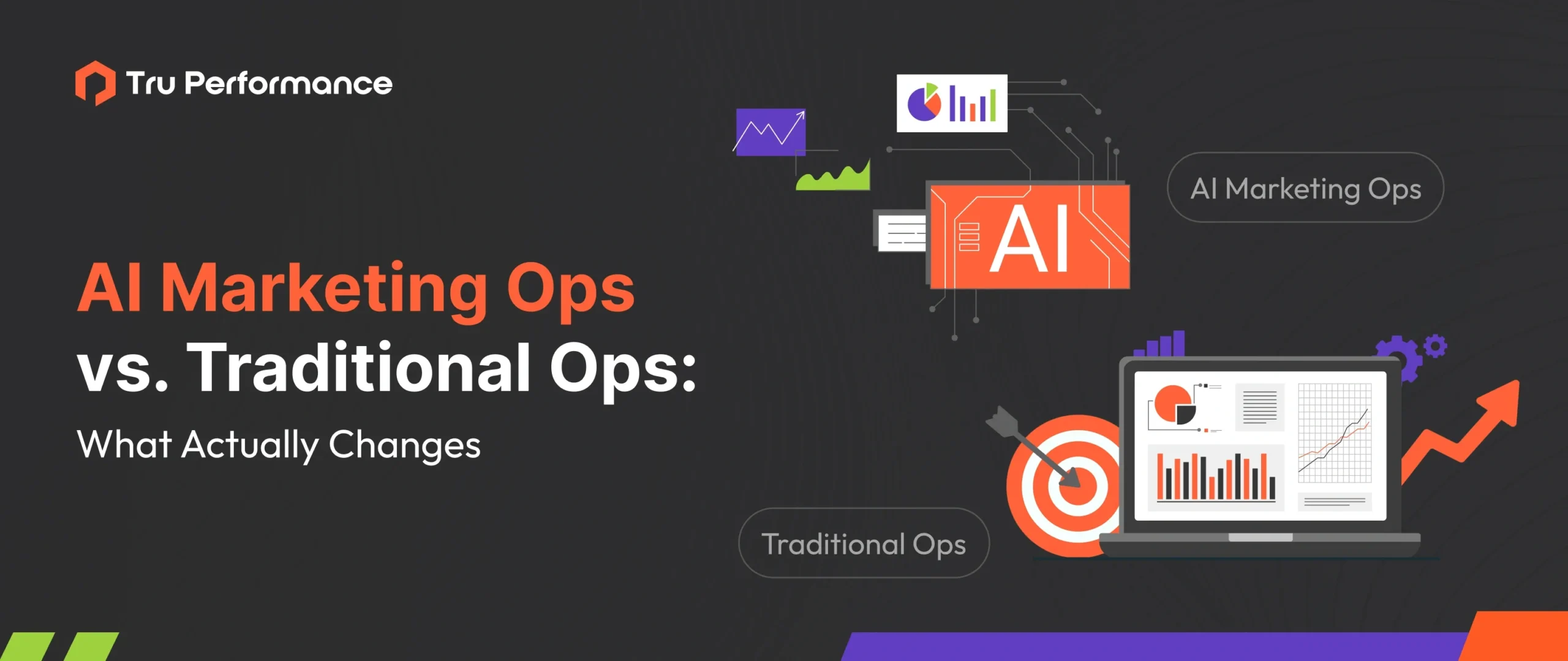
Article Summary- Traditional marketing operations is human-executed work coordinated by humans.
- AI marketing operations is AI-executed work governed by humans.
- The difference shows up in nine concrete dimensions decision-making, cycle time, attribution, reporting, optimization, headcount allocation, governance, error mode, and unit economics.
- This guide breaks down each one side-by-side, names the metrics that prove the shift, and explains why “buying AI tools” and “doing AI marketing ops” are not the same thing.
The category confusion
The phrase “AI marketing ops” has gotten loose in 2026. Vendors use it to describe any marketing platform that has an AI feature button. Agencies use it to describe everything from prompt engineering to a full RevOps rebuild. CMOs use it interchangeably with “AI in marketing,” “marketing automation 2.0,” and “RevOps with AI.”
This guide draws the line where it actually sits in operational practice. Traditional marketing operations is human-executed work coordinated by humans. AI marketing operations is AI-executed work governed by humans. Everything else is augmentation, which is valuable but is not the category we’re talking about here.
If you want the foundational view of the category, our AI-Powered Marketing Operations pillar guide walks through the 5-stage Maturity Model and the 90-day path most teams use to make the shift.
The nine dimensions where everything changes
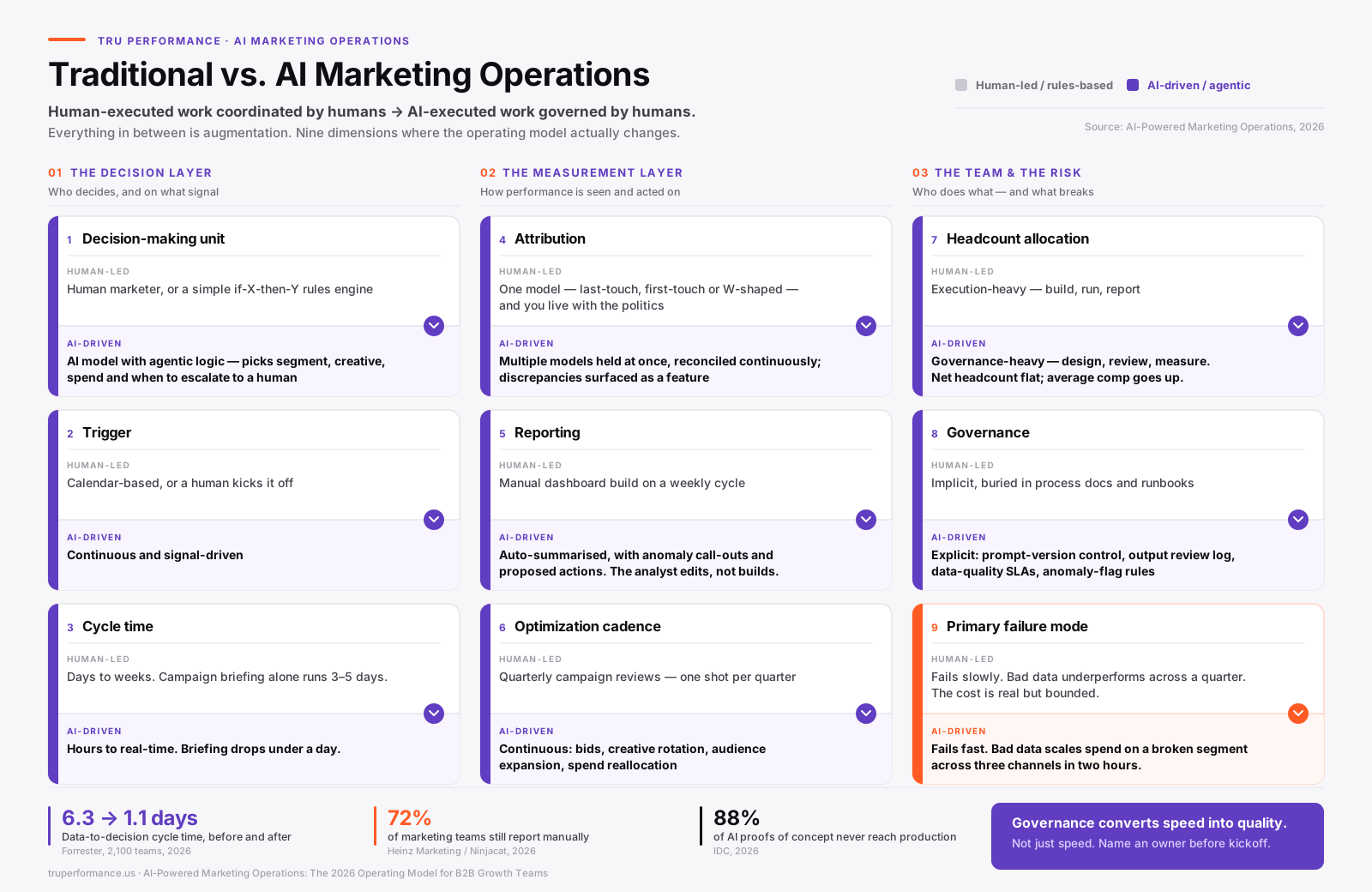
The shift happens across nine dimensions of how the marketing operations team works. Side-by-side:
| Dimension | Human-led / rules-based | AI-driven / agentic |
|---|---|---|
| Decision-making unit | Human marketer or rules engine | AI model with agentic logic |
| Trigger | Calendar or human-initiated | Continuous signal-driven |
| Cycle time | Days to weeks | Hours to real-time |
| Attribution | Last-touch or single-model multi-touch | Multi-model with cross-channel inference |
| Reporting | Manual dashboard build, weekly cycle | Auto-summarized with anomaly callouts |
| Optimization | Quarterly campaign reviews | Continuous spend + creative rotation |
| Headcount allocation | Execution-heavy (build, run, report) | Governance-heavy (design, review, measure) |
| Governance | Implicit, in process documents | Explicit: prompt versions, model monitoring, data SLAs |
| Primary failure mode | Slow to act on bad data | Fast to act on bad data |
That last row is the one most teams underestimate. AI marketing ops doesn’t reduce risk it changes the shape of risk. The traditional model fails slowly: bad data leads to bad campaigns that underperform over a quarter. The AI model fails fast: bad data leads to bad decisions deployed across channels in hours. Governance exists to convert speed into quality, not just speed.
Dimension 1: Decision-making unit
In traditional ops, decisions are made by humans (the marketer chooses the segment) or by simple rules engines (if X then Y). In AI marketing ops, models make decisions: which segment to target, which creative to serve, when to pause spend, when to escalate to a human.
The marketer’s job becomes: define the objective, define the constraints, set the exception threshold. This is more strategic work, less execution work and most marketers find the transition energizing once the governance is in place.
Dimension 2: Cycle time
Forrester’s 2,100-team study found the average data-to-decision cycle compressed from 6.3 days to 1.1 days once AI analytics entered the workflow. Campaign briefing drops from 3–5 days to under a day. Reporting compresses from a weekly ritual to continuous. The compounding effect across multiple workflows is what makes the operating-model shift feel like a different job, not just a faster one.
Dimension 3: Attribution
This is where most CMOs feel the difference first. Traditional attribution forces a single model last-touch, first-touch, W-shaped, position-based and lives with the political consequences. AI attribution maintains multiple models simultaneously, reconciles them continuously, and surfaces the discrepancies as a feature rather than a bug.
The internal attribution debate stops being about which model is “right” and starts being about which model the CFO will defend for budget allocation. That is a healthier debate.
Dimension 4: Reporting
Manual dashboard builds disappear. 72% of marketing teams in 2026 still report highly manual reporting processes despite widespread AI adoption (Heinz Marketing / Ninjacat AI Maturity Gap report, 2026) — which means most teams are getting AI tools without changing the reporting workflow. The teams that have completed the shift get reports that summarize themselves, flag anomalies, and propose actions. The MarOps analyst reviews and edits, instead of building from scratch.
Dimension 5: Optimization cadence
Traditional optimization runs on a quarterly review cycle. AI optimization runs continuously — bid adjustments, creative rotation, audience expansion, spend reallocation, all updated within hours of new signal. This compounds: a campaign that gets 90 optimization opportunities per quarter instead of one outperforms by a measurable margin, every time.
For the cluster-level deep dive on what to optimize against, see our 12 KPIs to track on every AI marketing ops engagement.
Dimension 6: Headcount allocation
The headcount question is what makes this category change politically loaded. Here’s the honest version of what we see across our clients in 2026.
Total marketing ops headcount does not shrink in the first 18 months of an AI marketing ops migration. The composition shifts. Execution roles (dashboard builders, list pullers, reporting analysts) decline. Governance and design roles (workflow architects, prompt engineers, AI ops leads) grow. Net headcount is roughly flat, but the average comp goes up because the work is harder.
Teams that try to capture the AI savings as immediate headcount reduction usually regret it. The governance work absorbs the savings and the governance work is what determines whether the AI investment delivers measurable ROI.
Dimension 7: Governance
Traditional ops has implicit governance: process docs, runbooks, occasional QA. AI marketing ops requires explicit governance because the failure modes are different.
The four governance components every team needs:
- Prompt-version control — every prompt that drives a production workflow is versioned, dated, and owned
- Output review log — sampled AI outputs are reviewed weekly with disagreement rate tracked
- Data-quality SLAs — minimum completeness thresholds on the fields the AI depends on
- Anomaly-flag rules — defined thresholds at which the AI must escalate to a human
None of this exists in traditional ops because the rules are baked into the runbook. In AI ops, the rules live outside the runbook and need their own infrastructure.
Dimension 8: Error mode
Traditional ops fails slowly. Bad data leads to a campaign that underperforms over a quarter, which RevOps notices when they pull the report. The cost is real but bounded.
AI ops fails fast. Bad data leads to an AI deciding to scale spend on a malformed segment across three channels in two hours. The cost is potentially much larger because the speed is much higher. The fix is not “slow the AI down.” The fix is data quality and governance measuring the AI’s outputs against baseline, defining the anomaly thresholds that trigger a human, and treating prompt and model changes the way an engineering team treats production code.
This is the reason 88% of AI proofs of concept never reach production (IDC, 2026) and why 95% of enterprise AI pilots fail to deliver ROI (MIT Project NANDA, 2025). Teams build the AI and ignore the governance.
Dimension 9: Unit economics
Once the governance is in place, the unit economics shift in the team’s favor. McKinsey’s 2026 Global AI Survey reports AI content drafting at 3.2x average ROI and personalization engines at 2.7x but only for teams that measured against a pre-AI baseline. Marketing teams using AI-powered campaign optimization specifically report 60% reduction in manual work, 14.5% sales productivity lift, and 12.2% marketing overhead reduction (industry consolidation cited by Gartner, 2026).
These numbers compound when multiple workflows are running, which is why the path from one production AI workflow to three is where most of the financial return actually lives.
When NOT to make the shift
A few uncomfortable cases where AI marketing ops is the wrong call.
You haven’t fixed the data. AI on dirty data is worse than no AI. Only 16% of RevOps professionals trust their data accuracy (RevOps state-of-industry, 2026) if you’re in that 84%, the data project is the first AI marketing ops project.
You can’t fund governance. If the budget covers tools but not the workflow design, governance, and measurement work that surrounds them, the project is going to land in the 88% failure cohort. Half-doing AI marketing ops is worse than not doing it.
You’re rebranding marketing automation. Adding ChatGPT to your existing process is augmentation. It’s valuable. It’s not AI marketing ops, and selling it internally as such erodes the credibility you’ll need later when you actually do the operating-model rebuild.
What this means for your next planning cycle
If you’re heading into a planning cycle and AI marketing ops is on the table, three questions to answer before the conversation:
- What’s our current Maturity Stage? (See the 5-stage model in the pillar guide.) Be honest. Most teams are at Stage 0 or Stage 1 and call themselves Stage 2.
- Which two workflows are the highest-time, lowest-risk candidates for replacement? (Reporting and briefing are usually the right answers.) Our manual workflows guide breaks down all eight.
- Who owns governance? If the answer is “we’ll figure that out later,” the project is already in trouble. Name an owner before the kickoff.
What to read next
If you’re trying to assess where your team sits on the migration today, request a free B2B AI Marketing Ops audit — 30 minutes, no deck, no pitch