Published October 29, 2026 Demand Generation & Paid Media 10 min read

ABM for Mid-Market SaaS: A Practical Implementation Guide

Listen to this article
11:21
Article summary. ABM for mid-market SaaS is not a smaller version of enterprise ABM. It runs on the tools most teams already own, HubSpot and LinkedIn, aimed at a short list of named accounts that sales has agreed to work.  Nearly 80% of organizations say they run ABM, but only 29% of ABM teams are measured solely on ABM metrics, and nearly half still judge success by MQLs (6sense, 2025).  Start with the list, not the platform. Build it with sales from closed-won patterns, then split it into three tiers so personalization and spend go where deal size justifies them.  Map the buying group in every Tier 1 and Tier 2 account. A typical B2B purchase involves 13 internal stakeholders and nine external influencers (Forrester, 2026), so one engaged contact is not an engaged account.  Measure accounts, not leads: buying-group coverage, engagement, meetings, opportunities and pipeline from target accounts against the rest. A 90-day rollout gives a clean baseline; pipeline effects take two to three quarters. Account-based marketing at mid-market scale means a short, sales-approved list of named accounts, split into three tiers, worked by marketing and sales together through HubSpot and LinkedIn. You don't need an enterprise ABM platform to start. You need agreement on the list, a mapped buying group in each priority account, plays matched to each tier, and a scorecard that counts accounts and pipeline instead of MQLs.  What ABM means for a mid-market SaaS team Account-based marketing is the convert layer of demand generation pointed at a named list of accounts. Instead of generating leads and hoping the right companies show up, you decide which companies you want, then market and sell to the people inside them.  Enterprise ABM usually comes with a dedicated platform, an intent data contract and a team of specialists. A mid-market SaaS company with $5M to $100M in ARR rarely has any of that, and doesn't need it to start. What it needs is narrower and harder: a list sales believes in, a way to see who at each account is engaged, and the discipline to judge the program on pipeline from those accounts.  ABM is also not a separate strategy. It works best when demand creation has already made the target accounts familiar with your name, which is why it sits inside the four-layer engine in our B2B demand generation playbook rather than next to it.  Why most ABM programs stall ABM is now common. Mature ABM is not.  Nearly 80% of organizations report having an ABM program, but only 29% of ABM teams are measured solely through ABM-aligned metrics, and nearly half still measure success by MQLs, even from non-target accounts (6sense, The State of B2B Marketing Metrics in 2025, June 2025). Only 13% report closed-won revenue from ABM to the board (same report).  The typical buying decision involves 13 internal stakeholders and nine external influencers (Forrester, The State of Business Buying, 2026, January 2026).  Put together: most teams call it ABM, measure it like lead generation, and talk to one or two people in a committee of more than twenty. Each of the steps below fixes one of those gaps.  How to implement ABM in six steps Fewer accounts, more personalization at the top. Every tier is judged on pipeline from its own accounts.  Step 1: Build the account list with sales Start from your closed-won deals, not from a data vendor's filters. Pull the last 18 to 24 months of won and lost opportunities and look for the patterns that separate them: industry, employee count, tech stack, region, the trigger that started the deal, and deal size.  Turn those patterns into a written ICP, then build the list together with sales leadership. Every account on it should have a reason a rep can say out loud. If marketing builds the list alone, sales won't work it, and the program becomes account-filtered advertising.  A data warning before you start: if lifecycle stages, company associations or lead sources are unreliable in your CRM, fix that first. The RevOps processes your team should stop running manually cover most of the hygiene ABM depends on, and the RevOps readiness checklist helps you find the gaps.  Step 2: Tier the list Split the list into three tiers so effort follows deal size:  Tier Accounts Personalization Typical plays Sales involvement Tier 1 (one-to-one) 10 to 25 Account-specific content, offers and messaging Executive outreach, custom audits or business cases, events, direct sales sequences Named rep and marketer pair per account Tier 2 (one-to-few) 50 to 200 By industry or use-case cluster Cluster-specific LinkedIn ads and content, sales sequences by cluster Shared by the account team Tier 3 (one-to-many) A few hundred to a few thousand Light, by firmographic segment LinkedIn company-list ads, retargeting, nurture Sales follows up on engagement signals  The most common mistake is a Tier 1 that is too long. If sales can't name the next step for each Tier 1 account in a weekly meeting, the tier is too big.  Step 3: Map the buying group One engaged contact is not an engaged account. For every Tier 1 and Tier 2 account, list the roles that decide a purchase like yours: the economic buyer, the champion, the people who will use the product, the technical evaluator, finance and procurement. Then record who you know in each role and who you don't.  The gaps are your plan. An account where you know only the champion needs content and outreach aimed at finance and the economic buyer, not more of what the champion already likes.  Step 4: Set up HubSpot for ABM HubSpot ships with ABM properties that cover most of what a mid-market team needs. Target Account is a company checkbox, ICP Tier is a company property with three tiers, and Buying Role is a contact property that can hold several roles per contact (HubSpot Knowledge Base, account-based marketing, accessed October 2026). Once the tools are on, HubSpot creates segments for contacts by buying role and for contacts at target accounts. The full toolset needs Marketing Hub and Sales Hub at Professional or Enterprise.  Use them like this:  Mark target accounts manually, from the list sales approved, rather than by workflow.  Set ICP Tier to match your three tiers so reports and views can split by tier.  Fill Buying Role from the mapping in step 3, and review the gaps in the weekly account meeting.  Associate every deal with its company, or pipeline from target accounts will be undercounted.  If your stack has grown around HubSpot with separate tools for intent, enrichment and ads, check whether you need them all before adding an ABM platform. Our case for why fewer martech tools produce more pipeline applies here too.  Step 5: Launch plays by tier LinkedIn is the main paid channel for mid-market ABM, because it is the one place you can reach named companies and the roles inside them. Company list uploads need at least 300 rows and must match at least 300 LinkedIn members to serve, and LinkedIn recommends lists of 1,000 or more companies (LinkedIn Marketing Solutions Help, accessed October 2026).  That rules out uploading a 25-account Tier 1 list on its own. In practice:  Upload Tier 2 and Tier 3 together as one company list, and split campaigns by job function and seniority.  Reach Tier 1 through sales and content first, with LinkedIn company targeting as support rather than the main play.  Keep the creative ungated. Useful content earns attention from people who aren't buying yet; forms filter them out.  Our guide to splitting budget between LinkedIn Ads and Google Ads covers when a named account list should pull budget toward LinkedIn. Keep Google on brand and high-intent terms, so that when someone at a target account finally searches, you are there. Google Ads for B2B SaaS covers that side.  Step 6: Measure accounts, not leads Replace MQL targets with an account scorecard, reviewed weekly with sales and monthly with leadership:  Buying-group coverage: the share of mapped roles where you know and have reached a contact  Account engagement: target accounts with meaningful activity across ads, site visits, content and sales touches  Meetings with the buying group in Tier 1 and Tier 2 accounts  Opportunities and pipeline from target accounts, compared with non-target accounts of a similar size  Win rate and deal size for target accounts against the rest, once deals close  Report pipeline from the CRM, not the ad platforms, and agree in advance how ABM-sourced and ABM-influenced pipeline are defined. Our guide to building a B2B attribution model your CFO will trust covers those definitions, and why last-touch attribution hides most of your pipeline explains why ABM looks weak in last-touch reports.  Five mistakes that sink mid-market ABM A list marketing built alone. If sales didn't choose the accounts, sales won't work them. The list is a joint decision, reviewed every quarter.  Too many Tier 1 accounts. One-to-one personalization doesn't scale past what a rep and a marketer can discuss in a weekly meeting. Fifty "Tier 1" accounts is a Tier 2 list with a Tier 1 budget.  Personalization that stops at the name field. Putting the company name in an ad isn't account-based marketing. Personalization means content about the account's situation: its stack, its growth stage, the problem its leadership has talked about in public.  Buying ads before mapping buyers. Ads reach whoever LinkedIn decides is in the account. Without a buying-group map you can't tell whether the engagement came from the economic buyer or an intern.  Keeping MQL targets. Teams that keep MQL goals alongside ABM end up chasing form fills from non-target accounts, because that's what the target rewards. Replace MQLs with the account scorecard for the target list, and keep lead metrics only for inbound demand outside it.  The 90-day ABM rollout Days 1–30: list and foundations Analyze closed-won deals and write the ICP with sales leadership.  Build and tier the list: 10 to 25 Tier 1 accounts, 50 to 200 in Tier 2, the rest in Tier 3.  Set up HubSpot: target accounts, ICP tiers, buying roles and deal associations.  Days 31–60: buying groups and plays Map buying groups for every Tier 1 and Tier 2 account and log the gaps.  Launch LinkedIn company-list campaigns for Tier 2 and Tier 3, split by function and seniority.  Start Tier 1 plays: executive outreach and one account-specific asset per account.  Days 61–90: measure and adjust Run the first account review on coverage, engagement, meetings and pipeline.  Move accounts between tiers based on engagement, and drop the ones sales has stopped working.  Set the cadence: weekly account meeting with sales, monthly scorecard to leadership.  By day 90 you will have a list sales works, a baseline for every metric and early signals from Tier 1. Pipeline effects usually take two to three quarters, so judge the program on the leading indicators first. A revenue operations engine gives that cadence a named owner.  Get the next guide in your inbox. New pieces on demand generation, paid media and RevOps, written by the people running the programs. Subscribe to the Tru Performance newsletter.  What to read next The B2B demand generation playbook: where ABM fits in the four-layer demand engine  LinkedIn Ads vs Google Ads for B2B: how a named account list changes your budget split  Building a B2B attribution model your CFO will trust: how to report ABM pipeline to finance  Tru Performance runs demand generation and ABM programs for mid-market B2B SaaS teams, inside the HubSpot and LinkedIn accounts they already have. If you want help building the first list and scorecard, talk to us. 
ABM for Mid-Market SaaS_ A Practical Implementation Guide-1 1

Article Summary

  • ABM for mid-market SaaS is not a smaller version of enterprise ABM. It runs on the tools most teams already own, HubSpot and LinkedIn, aimed at a short list of named accounts that sales has agreed to work. 
  • Nearly 80% of organizations say they run ABM, but only 29% of ABM teams are measured solely on ABM metrics, and nearly half still judge success by MQLs (6sense, 2025). 
  • Start with the list, not the platform. Build it with sales from closed-won patterns, then split it into three tiers so personalization and spend go where deal size justifies them. 
  • Map the buying group in every Tier 1 and Tier 2 account. A typical B2B purchase involves 13 internal stakeholders and nine external influencers (Forrester, 2026), so one engaged contact is not an engaged account. 
  • Measure accounts, not leads: buying-group coverage, engagement, meetings, opportunities and pipeline from target accounts against the rest. A 90-day rollout gives a clean baseline; pipeline effects take two to three quarters.
Explore AI Summary

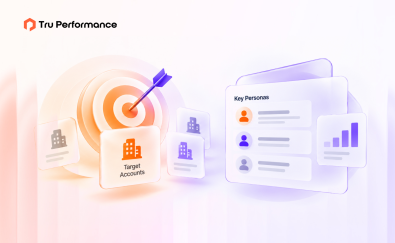
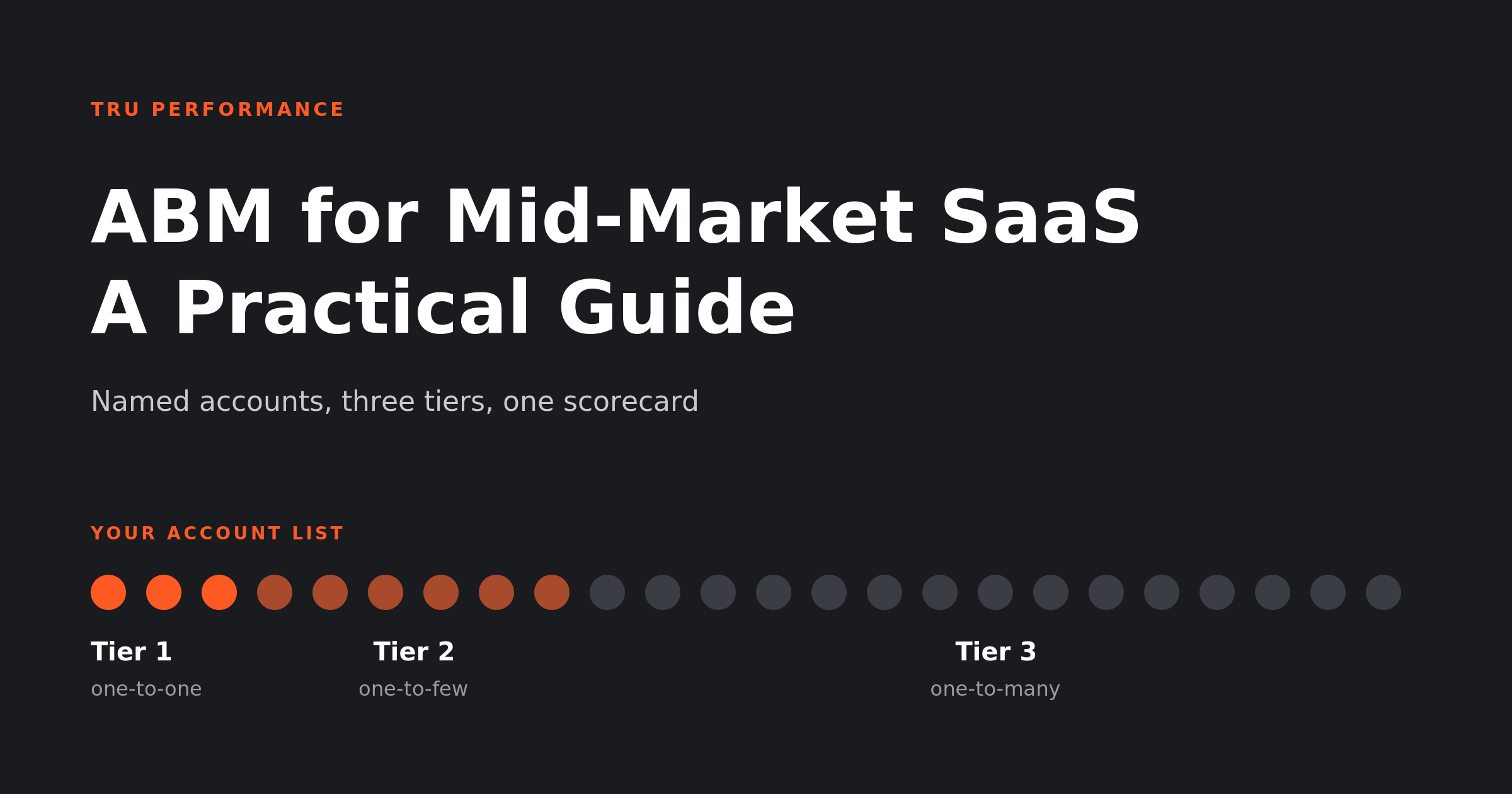
Title graphic for the Tru Performance guide to ABM for mid-market SaaS, showing a row of accounts grouped into three tiers

Account-based marketing at mid-market scale means a short, sales-approved list of named accounts, split into three tiers, worked by marketing and sales together through HubSpot and LinkedIn. You don’t need an enterprise ABM platform to start. You need agreement on the list, a mapped buying group in each priority account, plays matched to each tier, and a scorecard that counts accounts and pipeline instead of MQLs. 

What ABM means for a mid-market SaaS team

Account-based marketing is the convert layer of demand generation pointed at a named list of accounts. Instead of generating leads and hoping the right companies show up, you decide which companies you want, then market and sell to the people inside them. 

Enterprise ABM usually comes with a dedicated platform, an intent data contract and a team of specialists. A mid-market SaaS company with $5M to $100M in ARR rarely has any of that, and doesn’t need it to start. What it needs is narrower and harder: a list sales believes in, a way to see who at each account is engaged, and the discipline to judge the program on pipeline from those accounts. 

ABM is also not a separate strategy. It works best when demand creation has already made the target accounts familiar with your name, which is why it sits inside the four-layer engine in our B2B demand generation playbook rather than next to it. 

Why most ABM programs stall

ABM is now common. Mature ABM is not. 

  • Nearly 80% of organizations report having an ABM program, but only 29% of ABM teams are measured solely through ABM-aligned metrics, and nearly half still measure success by MQLs, even from non-target accounts (6sense, The State of B2B Marketing Metrics in 2025, June 2025).
  • Only 13% report closed-won revenue from ABM to the board (same report). 
  • The typical buying decision involves 13 internal stakeholders and nine external influencers (Forrester, The State of Business Buying, 2026, January 2026). 

Put together: most teams call it ABM, measure it like lead generation, and talk to one or two people in a committee of more than twenty. Each of the steps below fixes one of those gaps. 

How to implement ABM in six steps
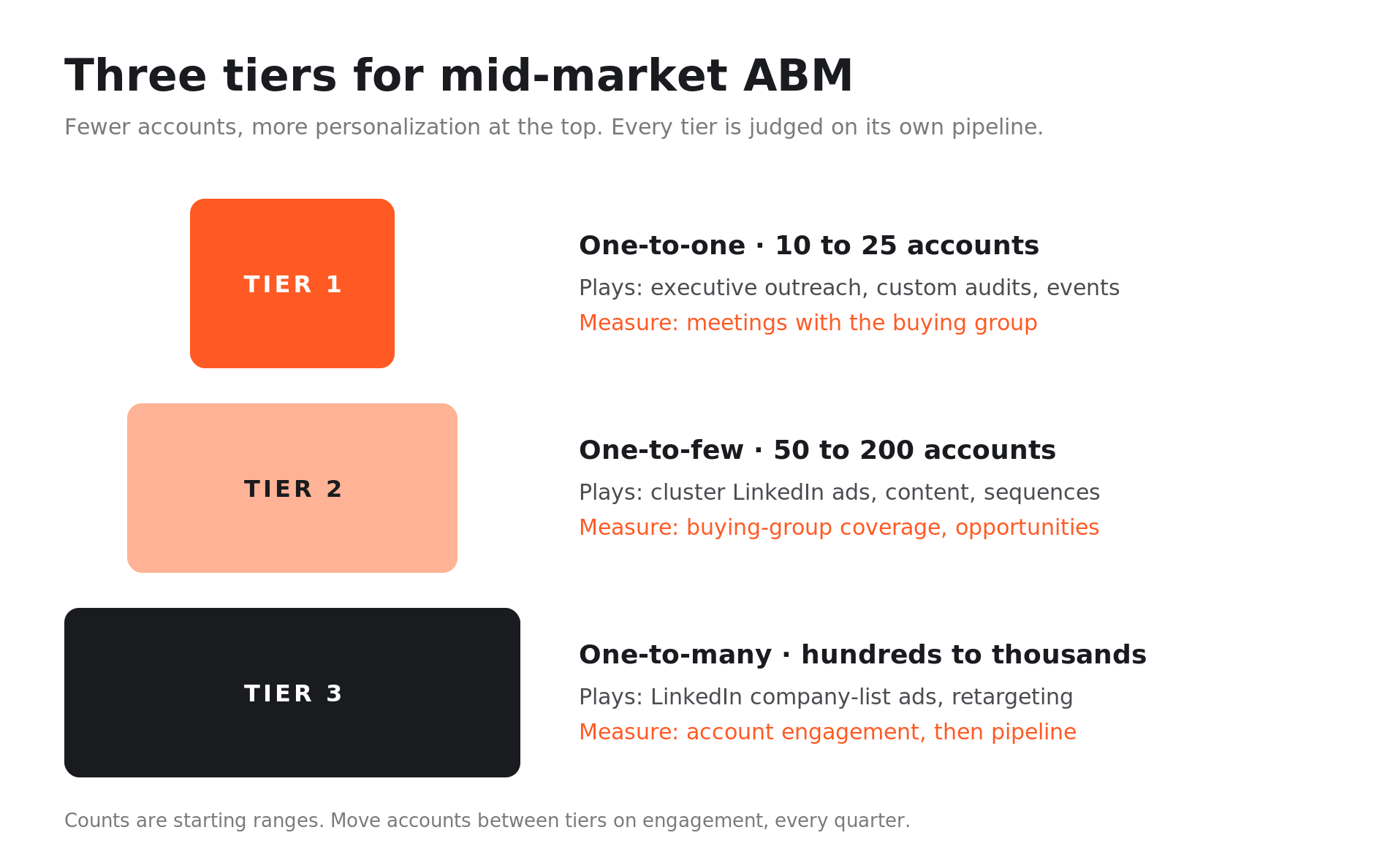
Three-tier account pyramid for mid-market SaaS ABM: 10 to 25 one-to-one accounts at the top, 50 to 200 one-to-few accounts in the middle and a few hundred to a few thousand one-to-many accounts at the base, with the plays and metric for each tier

Fewer accounts, more personalization at the top. Every tier is judged on pipeline from its own accounts. 

Step 1: Build the account list with sales

Start from your closed-won deals, not from a data vendor’s filters. Pull the last 18 to 24 months of won and lost opportunities and look for the patterns that separate them: industry, employee count, tech stack, region, the trigger that started the deal, and deal size. 

Turn those patterns into a written ICP, then build the list together with sales leadership. Every account on it should have a reason a rep can say out loud. If marketing builds the list alone, sales won’t work it, and the program becomes account-filtered advertising. 

A data warning before you start: if lifecycle stages, company associations or lead sources are unreliable in your CRM, fix that first. The RevOps processes your team should stop running manually cover most of the hygiene ABM depends on, and the RevOps readiness checklist helps you find the gaps. 

Step 2: Tier the list

Split the list into three tiers so effort follows deal size: 

Tier Accounts Personalization Typical plays Sales involvement
Tier 1 (one-to-one) 10 to 25 Account-specific content, offers and messaging Executive outreach, custom audits or business cases, events, direct sales sequences Named rep and marketer pair per account
Tier 2 (one-to-few) 50 to 200 By industry or use-case cluster Cluster-specific LinkedIn ads and content, sales sequences by cluster Shared by the account team
Tier 3 (one-to-many) A few hundred to a few thousand Light, by firmographic segment LinkedIn company-list ads, retargeting, nurture Sales follows up on engagement signals

 The most common mistake is a Tier 1 that is too long. If sales can’t name the next step for each Tier 1 account in a weekly meeting, the tier is too big. 

Step 3: Map the buying group

One engaged contact is not an engaged account. For every Tier 1 and Tier 2 account, list the roles that decide a purchase like yours: the economic buyer, the champion, the people who will use the product, the technical evaluator, finance and procurement. Then record who you know in each role and who you don’t. 

The gaps are your plan. An account where you know only the champion needs content and outreach aimed at finance and the economic buyer, not more of what the champion already likes. 

Step 4: Set up HubSpot for ABM

HubSpot ships with ABM properties that cover most of what a mid-market team needs. Target Account is a company checkbox, ICP Tier is a company property with three tiers, and Buying Role is a contact property that can hold several roles per contact (HubSpot Knowledge Base, account-based marketing, accessed October 2026). Once the tools are on, HubSpot creates segments for contacts by buying role and for contacts at target accounts. The full toolset needs Marketing Hub and Sales Hub at Professional or Enterprise. 

Use them like this: 

  • Mark target accounts manually, from the list sales approved, rather than by workflow. 
  • Set ICP Tier to match your three tiers so reports and views can split by tier. 
  • Fill Buying Role from the mapping in step 3, and review the gaps in the weekly account meeting. 
  • Associate every deal with its company, or pipeline from target accounts will be undercounted. 

If your stack has grown around HubSpot with separate tools for intent, enrichment and ads, check whether you need them all before adding an ABM platform. Our case for why fewer martech tools produce more pipeline applies here too. 

Step 5: Launch plays by tier

LinkedIn is the main paid channel for mid-market ABM, because it is the one place you can reach named companies and the roles inside them. Company list uploads need at least 300 rows and must match at least 300 LinkedIn members to serve, and LinkedIn recommends lists of 1,000 or more companies (LinkedIn Marketing Solutions Help, accessed October 2026). 

That rules out uploading a 25-account Tier 1 list on its own. In practice: 

  • Upload Tier 2 and Tier 3 together as one company list, and split campaigns by job function and seniority. 
  • Reach Tier 1 through sales and content first, with LinkedIn company targeting as support rather than the main play. 
  • Keep the creative ungated. Useful content earns attention from people who aren’t buying yet; forms filter them out. 

Our guide to splitting budget between LinkedIn Ads and Google Ads covers when a named account list should pull budget toward LinkedIn. Keep Google on brand and high-intent terms, so that when someone at a target account finally searches, you are there. Google Ads for B2B SaaS covers that side. 

Step 6: Measure accounts, not leads

Replace MQL targets with an account scorecard, reviewed weekly with sales and monthly with leadership: 

  • Buying-group coverage: the share of mapped roles where you know and have reached a contact 
  • Account engagement: target accounts with meaningful activity across ads, site visits, content and sales touches 
  • Meetings with the buying group in Tier 1 and Tier 2 accounts 
  • Opportunities and pipeline from target accounts, compared with non-target accounts of a similar size 
  • Win rate and deal size for target accounts against the rest, once deals close 

Report pipeline from the CRM, not the ad platforms, and agree in advance how ABM-sourced and ABM-influenced pipeline are defined. Our guide to building a B2B attribution model your CFO will trust covers those definitions, and why last-touch attribution hides most of your pipeline explains why ABM looks weak in last-touch reports. 

Five mistakes that sink mid-market ABM

  • A list marketing built alone. If sales didn’t choose the accounts, sales won’t work them. The list is a joint decision, reviewed every quarter. 
  • Too many Tier 1 accounts. One-to-one personalization doesn’t scale past what a rep and a marketer can discuss in a weekly meeting. Fifty “Tier 1” accounts is a Tier 2 list with a Tier 1 budget. 
  • Personalization that stops at the name field. Putting the company name in an ad isn’t account-based marketing. Personalization means content about the account’s situation: its stack, its growth stage, the problem its leadership has talked about in public. 
  • Buying ads before mapping buyers. Ads reach whoever LinkedIn decides is in the account. Without a buying-group map you can’t tell whether the engagement came from the economic buyer or an intern. 
  • Keeping MQL targets. Teams that keep MQL goals alongside ABM end up chasing form fills from non-target accounts, because that’s what the target rewards. Replace MQLs with the account scorecard for the target list, and keep lead metrics only for inbound demand outside it. 

The 90-day ABM rollout

Days 1–30: list and foundations

  • Analyze closed-won deals and write the ICP with sales leadership. 
  • Build and tier the list: 10 to 25 Tier 1 accounts, 50 to 200 in Tier 2, the rest in Tier 3. 
  • Set up HubSpot: target accounts, ICP tiers, buying roles and deal associations. 

Days 31–60: buying groups and plays

  • Map buying groups for every Tier 1 and Tier 2 account and log the gaps. 
  • Launch LinkedIn company-list campaigns for Tier 2 and Tier 3, split by function and seniority. 
  • Start Tier 1 plays: executive outreach and one account-specific asset per account. 

Days 61–90: measure and adjust

  • Run the first account review on coverage, engagement, meetings and pipeline. 
  • Move accounts between tiers based on engagement, and drop the ones sales has stopped working. 
  • Set the cadence: weekly account meeting with sales, monthly scorecard to leadership. 

By day 90 you will have a list sales works, a baseline for every metric and early signals from Tier 1. Pipeline effects usually take two to three quarters, so judge the program on the leading indicators first. A revenue operations engine gives that cadence a named owner. 

Get the next guide in your inbox. New pieces on demand generation, paid media and RevOps, written by the people running the programs. Subscribe to the Tru Performance newsletter. 

What to read next

Tru Performance runs demand generation and ABM programs for mid-market B2B SaaS teams, inside the HubSpot and LinkedIn accounts they already have. If you want help building the first list and scorecard, talk to us. 

Denver Mascarenhas

Vice President, Growth and Innovation, Tru Performance

A performance marketing and RevOps leader with 15+ years building global marketing teams and the AI-powered growth and product-innovation programs that turn client marketing into measurable outcomes.

Frequently Asked Questions

Everything you need to know about the product and billing.

Account-based marketing for mid-market SaaS is a program that targets a short, sales-approved list of named companies, usually split into three tiers, and markets and sells to the buying group inside each one. It runs mostly on tools mid-market teams already own, such as HubSpot and LinkedIn, rather than an enterprise ABM platform. 

A common structure is 10 to 25 Tier 1 accounts with one-to-one plays, 50 to 200 Tier 2 accounts grouped by industry or use case, and a few hundred to a few thousand Tier 3 accounts reached through targeted advertising. Start smaller than you think and expand once Tier 1 shows meetings and pipeline. 

No. A mid-market team can start with HubSpot’s built-in ABM tools, which include the Target Account, ICP Tier and Buying Role properties, plus LinkedIn company-list targeting. An ABM platform becomes worth evaluating once the list, the buying-group mapping and the scorecard are working and you need more scale or intent data. 

Mark the sales-approved accounts with the Target Account property, set the ICP Tier property to your three tiers, record each contact’s Buying Role, and associate every deal with its company. HubSpot then creates segments for target-account contacts and buying roles. The full ABM toolset requires Marketing Hub and Sales Hub at Professional or Enterprise. 

Measure accounts rather than leads. Track buying-group coverage, account engagement, meetings with the buying group, opportunities and pipeline from target accounts compared with non-target accounts, and win rate and deal size once deals close. Avoid running ABM on MQL volume, which pulls the program back into lead generation. 

Leading indicators such as buying-group coverage, engagement and meetings show within the first 90 days. Pipeline and revenue effects usually take two to three quarters, because ABM works on accounts across a long buying cycle. Judge the first quarter on leading indicators and the following quarters on pipeline. 

Insights from experts driving results on the ground

ABM for Mid-Market SaaS: A Practical Implementation Guide
9 min read

ABM for Mid-Market SaaS: A Practical Implementation Guide

Account-based marketing at mid-market scale means a short, sales-approved list of named accounts, split into three tiers, worked by marketing...
Read more
LinkedIn Ads vs Google Ads for B2B: Where to Put Your Next $50K
9 min read

LinkedIn Ads vs Google Ads for B2B: Where to Put Your Next $50K

LinkedIn Ads and Google Ads do different jobs, so the right split depends on your market, not on cost per...
Read more
Google Ads for B2B SaaS: Beyond Lead Gen to Pipeline Attribution
9 min read

Google Ads for B2B SaaS: Beyond Lead Gen to Pipeline Attribution

Most Google Ads accounts for B2B SaaS are tuned to the cheapest event they can count: a form fill. Smart...
Read more
B2B Demand Generation Strategy: A Full-Funnel Playbook for Paid Media, ABM and Pipeline
17 min read

B2B Demand Generation Strategy: A Full-Funnel Playbook for Paid Media, ABM and Pipeline

A B2B demand generation strategy is the system that creates buying intent, captures it when it surfaces, and turns it...
Read more
Explore resources