18 min read
 Article Summary
Article Summary- Choose in-house when the ranking assets are product-generated templates and the bottleneck is shipping code. Choose an agency when you need five specialisms in motion at once, when the work is a burst rather than a rhythm or when headcount is frozen and opex is not.
- A mid-level in-house SEO costs about $117,000 a year in employer cost at a 51 to 500 employee company, using Salary.com’s September 2026 base of $80,449 and the 46% benefits loading published by the US Bureau of Labor Statistics.
- A working tool stack runs about $21,166 a year at one seat and $31,188 at six. Six of the ten lines are metered on volume rather than seats, which is the structural reason an agency’s stack costs less per client.
- Conductor, BrightEdge, Botify and MarketMuse publish no price at all. Parts of the stack cannot be budgeted without a sales call. That procurement friction sits entirely in the in-house column.
- No independent survey of US B2B SaaS agency retainers exists for 2025 or 2026. Every widely quoted range traces back to agency blogs citing other agency blogs.
Your board asked why organic is flat. You have a plan, a keyword set and three technical fixes that have been written up twice. What you do not have is anyone whose actual job is to ship them.
So the question arrives the way it always does, as a budget line. Hire someone or retain an agency. Then it gets decided on a cost comparison that turns out to be the least useful way to look at it.
SEO agency vs in-house: which should you choose?
Choose in-house when the ranking assets are product-generated templates and the bottleneck is shipping code. Choose an agency when you need five specialisms in motion at once, when the work is a burst rather than a rhythm or when headcount is frozen and opex is not. The cost comparison rarely decides it.
Two numbers frame the decision. A mid-level in-house SEO at a company of 51 to 500 employees costs about $117,000 a year in employer cost, using Safaricom’s September 2026 base of $80,449 and the 46% benefits loading published by the US Bureau of Labor Statistics. A working tool stack adds roughly $21,000 at one seat.
Neither number settles it, because the stack does not scale the way people assume. Six of the ten tool lines are metered on crawled URLs, prompts, sites and keywords rather than on people. The same coverage costs about $31,188 at six seats. Headcount times six, stack cost times 1.47.
What actually decides the choice is whether the person accountable for organic can merge a pull request. An agency can diagnose, priorities and write the spec. None of that ships a template change.
A disclosure before the numbers
Every comparison ranking for this term is published by an agency and almost all conclude that you should hire an agency. Two of the top five give the agency column five advantages and the in-house column three. Tru Performance runs SEO and AEO engagements for B2B SaaS companies so we have the same conflict.
What follows is the framework we use on discovery calls, including the conditions under which we tell a prospect to hire instead. It also carries the evidence that runs against us, quoted in full further down.
Every number has a named source and a date. Where the evidence does not exist, this page says so rather than quoting a range.
What does an in-house SEO actually cost in 2026?
A mid-level in-house SEO costs roughly $117,000 a year in total employer cost and an SEO Director roughly $182,000, before tools. Salary is about two thirds of it.
The salary is not the cost
Most pages in this category apply a vague benefits multiplier of “roughly 35%” with nothing behind it. The real figure is published quarterly and free.
The BLS Employer Costs for Employee Compensation release for June 2026 puts total hourly employer cost for management and professional occupations in private industry at $78.88, of which $54.06 is wages.
Benefits and legally required contributions add 46% on top of base pay. For the information industry the loading is 54%.
Run it against real bases
Salary.com, as of 1 September 2026, puts an SEO Specialist I at a company with 51 to 500 employees at $80,449.
| Role | Base | Loaded at 46% |
|---|---|---|
| SEO Specialist I, 51 to 500 employees | $80,449 | ~$117,000 |
| SEO Director | $124,960 | ~$182,000 |
One caveat. BLS has no occupation code for SEO. Every salary figure here comes from a commercial aggregator. The same title spans $55,503 to $123,474 depending on whose method you use.
What nobody can quote you
There is no independent, methodology-backed survey of US B2B SaaS agency retainers for 2025 or 2026. We looked specifically.
The $5,000 to $15,000 a month range you see everywhere traces to agency blogs citing other agency blogs. The most-repeated figure, $3,209 a month, comes from a poll of 439 providers that is global, seller-reported and roughly three years old.
Anyone quoting you a market rate with confidence is quoting themselves.
What does an SEO tool stack cost and how does it scale?
A working stack covering technical, content, AI visibility, digital PR and testing costs about $21,166 a year at one seat and about $31,188 at six seats, using published September 2026 list prices. Stack cost scales with coverage and volume rather than with headcount.
Three of the four enterprise platforms will not tell you the price.
We checked every vendor pricing page on 17 September 2026.
- Conductor. No public price. Three tiers, all “request a demo.”
- BrightEdge. No public price. The pricing page is a contact form with no number, no range, no “starting at.”
- Botify. No public price. /pricing redirects to a demo request.
- seoClarity. Publishes, from $2,500 to $4,500 a month by tier. Its own footnote dates the packages to October 2022.
MarketMuse does not publish a price for any tier, including its free one.
A VP cannot build a business-case line for a tool whose vendor will not quote without a sales call. That procurement friction is a cost the in-house column carries and the agency column does not. No comparison page mentions it.
What a working stack actually costs
Here is the arithmetic for one in-house generalist. These are published list prices summed by us, not a benchmark. Any real buyer negotiates.
| Line | Annual | Moves with headcount? |
|---|---|---|
| Ahrefs Standard | $2,988 | Yes |
| Screaming Frog SEO Spider | $279 | Yes |
| Screaming Frog Log File Analyser | $139 | Yes |
| JetOctopus Pro, crawl and logs at scale | $6,588 | No |
| Clearscope Business | $4,788 | No |
| Otterly.AI Standard, AI visibility | $1,920 | No |
| BuzzStream Starter, digital PR | $588 | Yes |
| SEOTesting, single site | $600 | No |
| DebugBear | $588 | No |
| AccuRanker Professional | $2,688 | No |
| Total at one seat | $21,166 |
Swap SEOTesting for SearchPilot Core and add $36,900. Swap Otterly for the full Ahrefs AI Visibility Index and add $6,468. Use Muck Rack instead of BuzzStream and you cannot get a number at all.
The number that actually matters
Six of those ten lines never move when you add people. They are metered on crawled URLs, log lines, prompts, sites, page views and keywords.
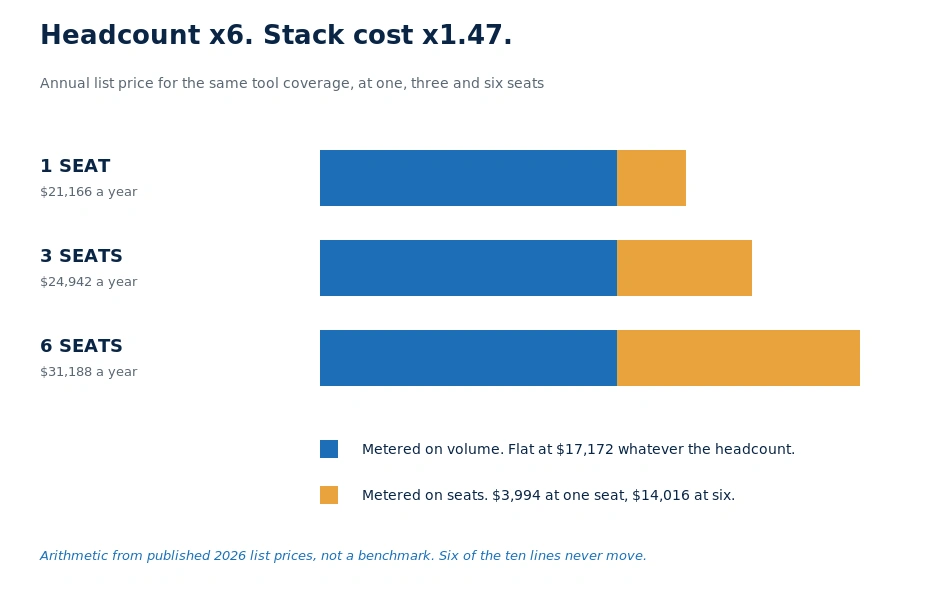
Headcount times six. Stack cost times 1.47. The flat lines hold at $17,172 whether one person or six use them. The whole increase sits in four seat-metered lines that go from $3,994 to $14,016.
That asymmetry is the structural argument, not the one agencies usually make. An agency is not cheaper because it negotiates better. It is cheaper per client because it amortises the six flat lines across the whole book, while your team amortises them across one domain.
One honest qualifier. Flat does not mean infinite. Six clients’ worth of crawling pushes JetOctopus from Pro to Ultra, roughly doubling that line.
What can an agency give you that a subscription cannot?
Coverage and availability, not price. Tools are the easy part of this comparison. The harder part is who operates them. Most in-house SEOs are operating alone.
Most in-house SEOs are on their own
34% of in-house technical SEOs are solely responsible for SEO at their organisation. A further 78% use no external agency or freelancer support for technical work. That is Aira and Women in Tech SEO’s State of Technical SEO 2024, from 382 respondents with published methodology.
An independent survey of news publishers landed on the identical 34%. Two self-selected samples converging is worth a sentence rather than a conclusion.
The job absorbed a second function without gaining a person
AI search optimisation is owned by the existing SEO team at 77% of organisations. Dedicated AI-search specialists account for 4%. That is Aleyda Solís’s State of AI Search Optimization 2026, fielded in August 2026.
The same survey names thirteen distinct AEO activities, from structured data and entity signals to prompt research, digital PR and community presence. Aira’s technical-SEO skill list runs to ten items on its own, including JavaScript, log file analysis, RegEx and SQL.
Nobody publishes a credible count of how many specialisms modern SEO requires. We are not going to invent one. Read those two lists and decide whether one hire covers them.
The in-housing research makes the agency case better than agencies do
The ANA’s own study of in-house agencies found that 82% of members run one, that 65% moved established work in-house in the past three years. The top-ranked benefit was cost efficiency.
Then it found that 92% still use external agencies. It named two reasons: bandwidth and capacity, plus capability that does not exist internally.
That is the honest agency case, published by the study most hostile to it. Not cheaper. Deeper. Available without a requisition.
What actually decides the choice?
Engineering access, not budget. An agency cannot fix a shipping problem. No retainer grants repo access. If template changes are stuck in a sprint queue, the model you pick will not unstick them.
Say your site runs on a code-deployed CMS. Template changes need a pull request and a sprint slot. The last three SEO recommendations are sitting in a doc because nobody owns the ticket. The bottleneck there is not SEO knowledge. You already know what to do.
Hiring an agency into that situation produces a better-argued backlog.
Three slots have to be filled and they are independently sourceable:
- Strategy. What to target, in what order and why. Either model works. A good agency is often better here because it sees patterns across accounts.
- Production. Briefs, drafts, technical fixes, schema, internal linking. Either model works and the economics turn on velocity.
- Engineering access. Changing a template and shipping it this sprint. Only in-house fills this.
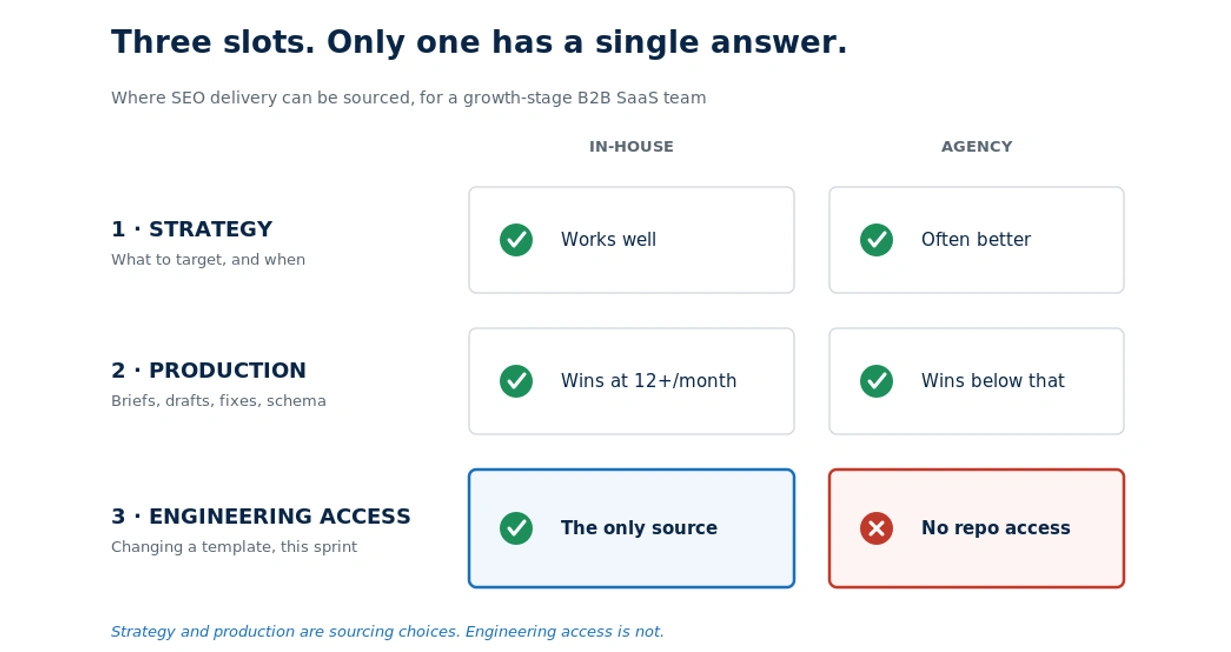
Most companies buy one model for all three slots, then wonder why the third one stays broken.
Four thresholds you can measure this week
Qualitative advice is why this decision stays stuck. Measure these instead.
- Product-object pages as a share of organic entrances. Pull organic landing pages in GA4. Above roughly 40% landing on templated pages built from product objects, integrations, use cases, comparisons or docs, the owner needs to sit in the product standup. Lean in-house.
- Publishing velocity. Below four pieces a month there is not a full-time job in it. Above twelve a month on a fixed template, in-house production wins per unit because briefing overhead amortises.
- Baseline traffic on ICP pages. Below about 500 organic sessions a month you do not yet know what your SEO job is. A full-time hire is an expensive diagnostic.
- Senior direction available. Can someone senior give the work two hours a week? If not, an agency’s account structure is the management layer you are actually buying.
How do you build a business case a CFO will approve?
Drop the opex argument. Both an employee and an agency are operating expense. No accounting treatment favors either. What differs is cash, commitment, reversibility and the approval path.
There is no accounting arbitrage
Marketing and advertising costs are expensed under ASC 720-35. There is no capitalization route. SEO work is SG&A whether an employee or an agency does it.
If anyone tells you vendor spend is “opex” and headcount is something else, they are wrong. Both are opex.
What genuinely differs
Three things, none of them accounting rules.
- Cash and commitment. An FTE is an indefinite commitment at a known annual cost. A retainer is a defined term. The term is what you negotiate.
- Approval path. A headcount requisition runs through People, a finance partner and a headcount committee against an annual plan. A vendor line runs through procurement by dollar threshold. That is delegation-of-authority policy rather than GAAP. It is the mechanism behind “we have the budget but cannot hire.”
- Reversibility, both ways. Agency contracts commonly carry 30 to 90 day termination for convenience. That cuts the other way too: minimum commitments and auto-renewal can make a vendor harder to stop than a person.
The 2026 conditions your case lands in
The money is flat. The people line is where the squeeze landed.
- Marketing budgets sit at 7.8% of revenue, which Gartner notes is 18% below the level of four years earlier. 56% of CMOs say they lack the budget to deliver their 2026 strategy.
- The CMO Survey’s April 2026 read has marketing headcount growth down more than 50% year on year, while B2B digital spend still grew 4.1% to 7.1%.
- Announced US tech job cuts reached 155,126 in the first eight months of 2026, up 52% on the same period in 2025, with AI the leading stated reason for five consecutive months.
We are not claiming companies are structurally shifting budget from employees to vendors. We looked for that data and it does not exist. What is evidenced is narrower: budgets are flat, headcount is frozen and the work still has to get done.
Two costs to put in the model, at their honest size
Ramp. Budget roughly six months before a specialist hire reaches full productivity. The best figure available is 6.2 months, from The Bridge Group’s June 2026 study of 158 B2B companies. Those are commercial roles rather than marketing specialists. Label it a proxy.
Turnover. The median cost of replacing an employee is 21% of annual salary, from the Center for American Progress’s pooled review of 30 case studies. That is far below the figures circulating here. “Six to nine months of salary,” “30% of first-year earnings” and “33% of base” are all folklore, listed at the foot of this page.
What does the evidence against agencies say?
A framework that only produces reasons to hire us is a sales deck. Four pieces of evidence cut the other way.
The fiduciary gap is documented by the industry’s own investigator
The ANA’s 2016 K2 Intelligence study found non-transparent practices pervasive across US media buying, including markups of roughly 30% to 90% on principal transactions. Its core finding was that advertisers believed agencies owed them a duty of care while many agency executives said the relationship was defined solely by the contract. Some contracts had gone unreviewed for ten years.
That study covers media buying rather than SEO. The behaviour it describes is a contracting problem you can solve on day one.
A quarter of agency staff turn over every year
The IPA’s 2025 census puts UK agency staff turnover at 24.8%, with retention down to 68.6%. Measured, not modelled.
Your channel sits at the unstable end of agency relationships
Average client-agency tenure is now around seven years. The old churn narrative is dead. Break it apart though and integrated shops run 87 months while media and digital-only run 44. Tenure is also longest among clients who stopped running competitive reviews.
Your peers are cutting exactly what we sell
Forrester’s 2026 B2B survey found the share of marketers expecting to increase digital marketing agency spend fell from 51% to 31%. Content creation agency spend fell from 41% to 26%. Forrester attributes it to AI efficiencies letting teams bring work in-house.
One more, the most awkward of the set. The CMO Survey finds technology and software among the least-outsourced sectors at 28%, with B2B Product outsourcing falling. Your industry is moving away from this, not toward it. Any agency that does not tell you that is hoping you will not check.
Where do both models fail?
Neither fixes an unowned roadmap. If nobody internally can approve, prioritise and ship, both produce recommendations that decay on a shelf.
Neither fixes a measurement vacuum. With organic not wired to pipeline you cannot tell a good agency from a bad one or a good hire from a bad one. You optimise toward traffic because traffic is the only visible number.
No source anywhere compares in-house and agency outcomes. Every cost comparison in this category, including this one, compares inputs. Anyone claiming an outcome difference is guessing.
What changed in 2026?
The job grew a function. It was added on top rather than swapped in.
Semrush’s July 2026 study of more than 600,000 US desktop keywords found commercial-intent SERPs carrying an AI Overview grew 71% between November 2025 and April 2026. Commercial intent is where a page like this one lives.
Pew Research Center measured the consequence across 68,879 real searches. With an AI summary present, users clicked a traditional result on 8% of visits against 15% without. Pew is the only disinterested source here. Its data is from March 2025.
Meanwhile Wynter’s January 2026 survey of 101 mid-market B2B SaaS CMOs found 84% using LLMs for vendor discovery, up from 24% a year earlier.
Two consequences. A hiring case built on projected session volume rests on a number that moved. The skill you are sourcing also changed: you are no longer hiring someone to rank, you are hiring someone to become the source the model summarises. Our AI visibility analytics guide covers measurement and the GEO field guide covers the structural work.
80% of G2’s buyers still use Google somewhere. The fundamentals got a second scoreboard, not a replacement.
When should you hire each?
| Condition | In-house | Agency |
|---|---|---|
| Ranking assets are generated from product objects | ✅ Sit in the standup | ❌ Always one release behind |
| Bottleneck is shipping, not knowledge | ✅ Only if repo access comes with it | ❌ Cannot merge a pull request |
| Work is a burst: migration, replatform, IA rebuild | ❌ Permanent salary, temporary work | ✅ Four specialists for eight weeks |
| Need technical, content, digital PR, AEO and testing in motion now | ❌ One hire covers two well | ✅ You are buying coverage |
| Stack coverage matters more than headcount | ❌ One domain absorbs the full flat cost | ✅ Flat lines amortise across the book |
| Below 500 organic sessions a month on ICP pages | ❌ Expensive diagnostic | ✅ Cheaper and reversible |
| Publishing 12+ pieces a month in one category | ✅ Briefing overhead amortises | ❌ Per-unit cost climbs |
| Nobody senior can direct the work weekly | ❌ Becomes a ticket-taker | ✅ Account structure is the management layer |
| Headcount is frozen but opex is available | ❌ Requisition will not clear | ✅ Procurement path is open |
| SEO is permanent and institutional memory matters | ✅ It stays when the contract ends | ❌ The thinking leaves with the retainer |
Most growth-stage SaaS companies land on a split. One senior in-house owner who can direct work and ship code, with production and specialist depth bought in. Design that deliberately rather than arriving at it by accident.
How do you evaluate a hire or an agency?
For a hire. Test whether they can name the last template they changed and how it shipped. Ask what they would measure in month one. A candidate who leads with rankings rather than pipeline is answering a 2023 question.
For an agency. Read the team CVs for title inflation. An agency “SEO Director” at five years is not an in-house director at twelve. Ask which client they told to stop doing SEO. Ask what happens to your Search Console property, GA4 account, content and tracking on the day the contract ends. Get the answer into the MSA rather than the pitch.
For either. Ask ChatGPT, Perplexity and Google what the best B2B SaaS SEO agencies are. See whether the one pitching you appears. With 84% of mid-market CMOs now researching vendors in an LLM, an agency that cannot make itself visible in AI answers is showing you its work.
If you want a read on where you actually stand before you decide, we run a discoverability audit covering organic and AI visibility. It takes about a week. Roughly a third of the time it tells the company to hire rather than retain. See how our discoverability work runs. Or talk to a partner if you would rather start with the question.
Sourcing decisions hold when they are run as a system
This question gets re-litigated every year in most companies, because it is usually decided on a budget number and then reopened when the budget changes.
At Tru Performance, a business growth and operations partner working across 250+ brands and more than $500M in client revenue, discoverability work runs inside ConvergeOS™, our operating model that moves work through five stages: Diagnose, Design, Deploy, Operate and Compound. The sourcing decision belongs in Design, because who does the work is a structural choice rather than a procurement one. Get the three slots right and the model you pick matters far less than the fact that someone can ship.