What Is TOON (Token-Oriented Object Notation) and How It Helps Answer Engine Optimization (AEO)?

Published January 30, 2026 AEO 7 min read
Listen to this article
8:02
Article summary. Search has shifted to AI-driven answers, making Answer Engine Optimization (AEO) essential for structuring content so AI systems can easily extract and summarize it. TOON (Token-Oriented Object Notation) is a data format designed specifically for large language models (LLMs) to reduce wasted tokens while preserving structured data. JSON is inefficient for AI workflows because it repeats keys, adds unnecessary formatting characters, and consumes valuable context window space. TOON improves efficiency and clarity by declaring keys once, reducing formatting noise, explicitly defining structure, and cutting token usage by 30–60%. TOON supports AEO and AI workflows by enabling cleaner data input for chatbots, internal search tools, answer engines, and AI-powered content generation. TOON does not replace JSON-LD or schema markup on websites; it operates at the AI data-processing layer, optimizing how structured data is sent to and processed by AI systems. Search is changing fast. People no longer scroll through ten blue links. They ask questions and expect direct answers. Tools like Google AI Overviews, ChatGPT, voice assistants, and other AI answer engines now decide what information gets shown first. This shift has created a new discipline called Answer Engine Optimization (AEO). Instead of only ranking pages, the goal is to make your content easy for AI systems to understand, extract, and summarize. At the same time, the way we send structured data to AI models is also evolving. This is where TOON (Token-Oriented Object Notation) comes in. In this guide, you’ll learn: What TOON is and why it exists How it compares to JSON When TOON actually makes sense How TOON can support AEO workflows Practical examples, including organization schema-style data Let’s start with the basics. What Is TOON? TOON stands for Token-Oriented Object Notation. It is a data format designed specifically for working with large language models (LLMs). The main goal is simple: Reduce wasted tokens while keeping data structured and readable. JSON is great for software systems. But for AI prompts, it creates a lot of unnecessary overhead. Curly braces, repeated keys, quotation marks, and nested syntax all consume tokens. TOON removes much of that extra formatting and keeps only what the model needs. In simple terms Think of TOON as: JSON without clutter YAML-style readability CSV-style efficiency for tables Built for AI prompts, not browsers Why JSON Is Not Ideal for AI and Answer Engines JSON was never designed for AI consumption. It was built for machine-to-machine communication. Here’s where JSON struggles in AI workflows: 1. Too much repetition If you send a list of products in JSON, every product repeats the same keys: When you have hundreds of rows, this repetition adds thousands of unnecessary tokens. 2. Token limits matter Every AI model has a context window. The more tokens you waste on formatting, the less space you have for: Instructions Examples Supporting data Reasoning context This directly impacts answer quality. 3. Noise for language models LLMs read patterns. Extra syntax characters like {}, [], and quotes add noise. Fewer formatting tokens help models focus on actual values and meaning. What Makes TOON Different? TOON solves these problems by changing how structured data is represented. Here are the core ideas. 1. Keys are declared once Instead of repeating keys for every object, TOON defines them once at the top. Cleaner. Smaller. Easier for AI to parse. 2. Array length is explicit TOON declares how many rows exist: This gives the model structural certainty and reduces hallucination risk. 3. Human-readable layout TOON uses indentation similar to YAML. Even without tools, humans can quickly scan it. 4. Token savings are real Benchmarks show TOON often reduces token usage by 30% to 60% compared to JSON. That directly lowers API costs and allows more context inside prompts. Simple Comparison: JSON vs TOON Example: User profile Same meaning. Fewer tokens. Example: Product list Now imagine this with 1,000 products. That’s where TOON shines. Example: Organization Schema-Style Data Let’s say you want to provide organization information to an AI model for knowledge graph building, brand summaries, or internal answer engines. This format is: Easier for models to scan More compact Better suited for prompt-based knowledge extraction How TOON Connects With Answer Engine Optimization (AEO) Now let’s connect TOON to AEO. AEO focuses on making content easy for AI systems to extract answers from. This includes: Structured FAQs Product attributes Knowledge base entries Comparison tables Business facts When you use AI tools internally to: Generate answer snippets Validate schema content Build internal search assistants Power chatbots Prepare AI training data You often send structured data into models. This is where TOON adds value. Example: Feeding product data to an AI assistant Instead of sending bulky data comparing multiple phone battery life in JSON, Now the AI can answer: “Which phone has the best battery life?” With less token cost and clearer structure. Why this matters for AEO teams Better prompts mean: More accurate AI-generated answers Less hallucination More context per request Lower infrastructure cost Better internal content validation That directly supports high-quality answer engine visibility. As part of this shift, many teams are now adopting AI visibility analytics to measure how often their brand, products, and content appear inside AI-generated answers, summaries, and knowledge responses. While TOON does not directly influence rankings, improving how structured website data is processed by AI systems can support cleaner AI outputs that feed into these emerging visibility metrics. Important Clarification: TOON vs JSON-LD TOON does not replace JSON-LD on your website. Search engines still expect schema markup in JSON-LD format. Use: JSON-LD for publishing structured data on web pages TOON for AI workflows, prompt engineering, internal tools, and data pipelines They solve different problems. When You Should Use TOON TOON works best when: You send large uniform datasets to LLMs You work with tables or catalogs You build AI-powered search or assistants You optimize prompt efficiency You generate structured answers at scale When You Should Avoid TOON Stick with JSON when: Data is deeply nested and irregular Structures change frequently Human developers need strict validation tooling Browser compatibility is required For flat tables, CSV may even outperform TOON. How to Start Using TOON TOON is NOT implemented on your website the way schema, HTML, or JSON-LD is. It is a more convenient way for an AI system to convert bulky JSON data into a Token Oriented Format that becomes effective to read and understand. TOON is NOT implemented on your website the way schema markup, HTML structure, or JSON-LD are. From an SEO perspective, TOON does not replace any crawl-layer optimizations. Search engines and AI-powered crawlers still rely on traditional on-page signals such as semantic HTML, structured data markup, internal linking, and content structure. TOON is used at the data processing layer, after website content has already been indexed or extracted. In practical terms, TOON becomes relevant when structured website data is exported for AI-driven content workflows. This includes scenarios such as preparing FAQ datasets, product catalogs, service information, or knowledge base content that is later used by AI tools for summarization, validation, or answer generation. Instead of passing large JSON files into these systems, TOON allows the same structured information to be represented in a more compact and AI-efficient format. This helps reduce processing overhead while preserving data structure. Final Thoughts TOON is not a magic replacement for JSON. But it solves a real problem in AI workflows: wasted tokens and inefficient data formatting. For teams working on: AEO strategies AI search experiences Knowledge automation Prompt optimization Internal answer engines TOON offers a practical advantage. When combined with strong AEO foundations, such as clear content structure, schema markup, and question-based formatting, TOON can help you move faster and scale smarter in the AI-driven search era.   Is Your Content Ready to Be Cited by AI Engines? Most websites are still optimized for blue links, not AI answers. Find out how well your content is structured for ChatGPT, Perplexity, Google AI Overviews, and Claude — and uncover the technical gaps holding back your AEO performance. Book an AEO Audit


2078x876 (3) (1)

Article Summary

  • Search has shifted to AI-driven answers, making Answer Engine Optimization (AEO) essential for structuring content so AI systems can easily extract and summarize it.

  • TOON (Token-Oriented Object Notation) is a data format designed specifically for large language models (LLMs) to reduce wasted tokens while preserving structured data.

  • JSON is inefficient for AI workflows because it repeats keys, adds unnecessary formatting characters, and consumes valuable context window space.

  • TOON improves efficiency and clarity by declaring keys once, reducing formatting noise, explicitly defining structure, and cutting token usage by 30–60%.

  • TOON supports AEO and AI workflows by enabling cleaner data input for chatbots, internal search tools, answer engines, and AI-powered content generation.

  • TOON does not replace JSON-LD or schema markup on websites; it operates at the AI data-processing layer, optimizing how structured data is sent to and processed by AI systems.

Explore AI Summary

Search is changing fast.

People no longer scroll through ten blue links. They ask questions and expect direct answers. Tools like Google AI Overviews, ChatGPT, voice assistants, and other AI answer engines now decide what information gets shown first.

This shift has created a new discipline called Answer Engine Optimization (AEO). Instead of only ranking pages, the goal is to make your content easy for AI systems to understand, extract, and summarize.

At the same time, the way we send structured data to AI models is also evolving. This is where TOON (Token-Oriented Object Notation) comes in.

In this guide, you’ll learn:

  • What TOON is and why it exists
  • How it compares to JSON
  • When TOON actually makes sense
  • How TOON can support AEO workflows
  • Practical examples, including organization schema-style data

Let’s start with the basics.

What Is TOON?

TOON stands for Token-Oriented Object Notation.

It is a data format designed specifically for working with large language models (LLMs). The main goal is simple: Reduce wasted tokens while keeping data structured and readable.

JSON is great for software systems. But for AI prompts, it creates a lot of unnecessary overhead. Curly braces, repeated keys, quotation marks, and nested syntax all consume tokens.

TOON removes much of that extra formatting and keeps only what the model needs.

In simple terms

Think of TOON as:

  • JSON without clutter
  • YAML-style readability
  • CSV-style efficiency for tables
  • Built for AI prompts, not browsers

Why JSON Is Not Ideal for AI and Answer Engines

JSON was never designed for AI consumption. It was built for machine-to-machine communication.

Here’s where JSON struggles in AI workflows:

1. Too much repetition

If you send a list of products in JSON, every product repeats the same keys:

an image showing how a JSON formatting sends a lot of repeated keys

When you have hundreds of rows, this repetition adds thousands of unnecessary tokens.

2. Token limits matter

Every AI model has a context window. The more tokens you waste on formatting, the less space you have for:

  • Instructions
  • Examples
  • Supporting data
  • Reasoning context

This directly impacts answer quality.

3. Noise for language models

LLMs read patterns. Extra syntax characters like {}, [], and quotes add noise. Fewer formatting tokens help models focus on actual values and meaning.

What Makes TOON Different?

TOON solves these problems by changing how structured data is represented.

Here are the core ideas.

1. Keys are declared once

Instead of repeating keys for every object, TOON defines them once at the top.

image showing how many repeating keys comes with each object in JSON

image showing how TOON formatting defines repeating keys in one stop

Cleaner. Smaller. Easier for AI to parse.

2. Array length is explicit

TOON declares how many rows exist:

image showing how toon declares the number of rows

This gives the model structural certainty and reduces hallucination risk.

3. Human-readable layout

TOON uses indentation similar to YAML. Even without tools, humans can quickly scan it.

4. Token savings are real

Benchmarks show TOON often reduces token usage by 30% to 60% compared to JSON. That directly lowers API costs and allows more context inside prompts.

Simple Comparison: JSON vs TOON

Example: User profile
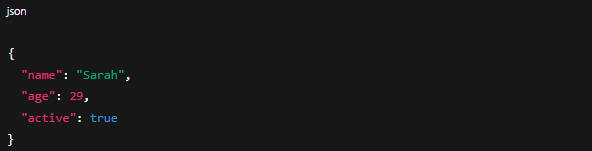
image showing example of a JSON formatting

image showing example Toon formatting without commas and semicolons

Same meaning. Fewer tokens.

Example: Product list
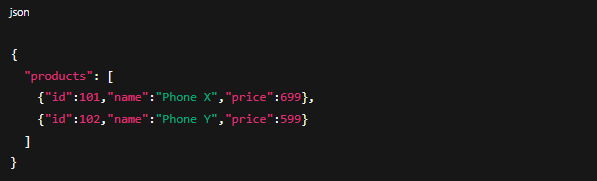
image showing example of JSON with product list schema

image showing toon formatting for the product schema

Now imagine this with 1,000 products. That’s where TOON shines.

Example: Organization Schema-Style Data

Let’s say you want to provide organization information to an AI model for knowledge graph building, brand summaries, or internal answer engines.
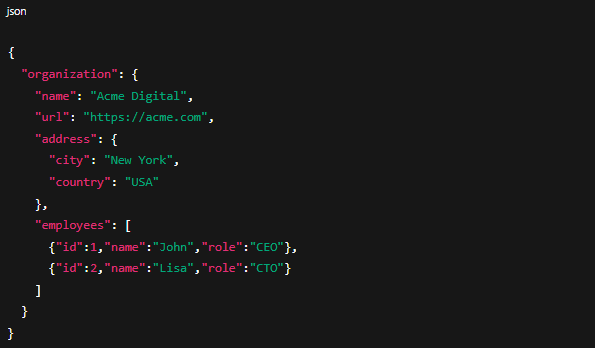

image showing an organization schema in JSON format

image showing an organization schema in TOON format

This format is:

  • Easier for models to scan
  • More compact
  • Better suited for prompt-based knowledge extraction

How TOON Connects With Answer Engine Optimization (AEO)

Now let’s connect TOON to AEO.

AEO focuses on making content easy for AI systems to extract answers from. This includes:

  • Structured FAQs
  • Product attributes
  • Knowledge base entries
  • Comparison tables
  • Business facts

When you use AI tools internally to:

  • Generate answer snippets
  • Validate schema content
  • Build internal search assistants
  • Power chatbots
  • Prepare AI training data

You often send structured data into models.

This is where TOON adds value.

Example: Feeding product data to an AI assistant

Instead of sending bulky data comparing multiple phone battery life in JSON,
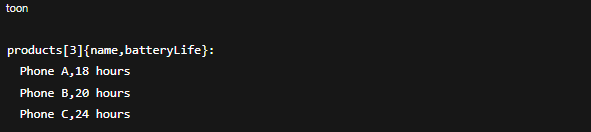
image showing an example of how TOON can be used to send bulky comparison data instead of JSON saving AI tokens

Now the AI can answer:

“Which phone has the best battery life?”

With less token cost and clearer structure.

Why this matters for AEO teams

Better prompts mean:

  • More accurate AI-generated answers
  • Less hallucination
  • More context per request
  • Lower infrastructure cost
  • Better internal content validation

That directly supports high-quality answer engine visibility.

As part of this shift, many teams are now adopting AI visibility analytics to measure how often their brand, products, and content appear inside AI-generated answers, summaries, and knowledge responses. While TOON does not directly influence rankings, improving how structured website data is processed by AI systems can support cleaner AI outputs that feed into these emerging visibility metrics.

Important Clarification: TOON vs JSON-LD

TOON does not replace JSON-LD on your website.

Search engines still expect schema markup in JSON-LD format.

Use:

  • JSON-LD for publishing structured data on web pages
  • TOON for AI workflows, prompt engineering, internal tools, and data pipelines

They solve different problems.

When You Should Use TOON

TOON works best when:

  • You send large uniform datasets to LLMs
  • You work with tables or catalogs
  • You build AI-powered search or assistants
  • You optimize prompt efficiency
  • You generate structured answers at scale

When You Should Avoid TOON

  • Stick with JSON when:
  • Data is deeply nested and irregular
  • Structures change frequently
  • Human developers need strict validation tooling
  • Browser compatibility is required
  • For flat tables, CSV may even outperform TOON.

How to Start Using TOON

TOON is NOT implemented on your website the way schema, HTML, or JSON-LD is.

It is a more convenient way for an AI system to convert bulky JSON data into a Token Oriented Format that becomes effective to read and understand.

TOON is NOT implemented on your website the way schema markup, HTML structure, or JSON-LD are.

From an SEO perspective, TOON does not replace any crawl-layer optimizations. Search engines and AI-powered crawlers still rely on traditional on-page signals such as semantic HTML, structured data markup, internal linking, and content structure.

TOON is used at the data processing layer, after website content has already been indexed or extracted.

In practical terms, TOON becomes relevant when structured website data is exported for AI-driven content workflows. This includes scenarios such as preparing FAQ datasets, product catalogs, service information, or knowledge base content that is later used by AI tools for summarization, validation, or answer generation.

Instead of passing large JSON files into these systems, TOON allows the same structured information to be represented in a more compact and AI-efficient format. This helps reduce processing overhead while preserving data structure.

Final Thoughts

TOON is not a magic replacement for JSON.

But it solves a real problem in AI workflows: wasted tokens and inefficient data formatting.

For teams working on:

  • AEO strategies
  • AI search experiences
  • Knowledge automation
  • Prompt optimization
  • Internal answer engines

TOON offers a practical advantage.

When combined with strong AEO foundations, such as clear content structure, schema markup, and question-based formatting, TOON can help you move faster and scale smarter in the AI-driven search era.


Is Your Content Ready to Be Cited by AI Engines?

Most websites are still optimized for blue links, not AI answers. Find out how well your content is structured for ChatGPT, Perplexity, Google AI Overviews, and Claude — and uncover the technical gaps holding back your AEO performance.
Book an AEO Audit

Frequently Asked Questions

All you need to know about TOON and its impact on AEO

No. TOON does not replace schema markup. Search engines still rely on JSON-LD and schema.org standards to understand website content. TOON is designed for AI data processing workflows, not for public website markup.

No. TOON is not meant to be embedded into HTML pages. It is used when structured website data is exported and processed by AI tools such as chatbots, content systems, or internal search platforms.

No. TOON is not a ranking factor. It does not affect crawling, indexing, or traditional SEO signals. Its benefit is indirect, helping AI systems process structured website data more efficiently.

TOON helps improve how structured website data is consumed by AI systems that generate answers, summaries, and search responses. By reducing data overhead and improving structure, it supports cleaner AI-generated outputs used in AEO workflows.

SEO teams should consider TOON when working with AI-driven content workflows such as FAQ generation, knowledge base processing, chatbot data preparation, or large-scale structured content analysis.

TOON is most useful when working with larger structured datasets or AI-powered tools. Smaller websites without AI-driven workflows may not see immediate benefits.

For public discoverability, websites should continue using semantic HTML, structured data markup (JSON-LD), optimized content structure, and internal linking. These remain the foundation of SEO and AEO.

Insights from experts driving results on the ground

SEO Agency vs In-House Team: How Growth-Stage SaaS Should Actually Decide
17 min read

SEO Agency vs In-House Team: How Growth-Stage SaaS Should Actually Decide

Your board asked why organic is flat. You have a plan, a keyword set and three technical fixes that have been written up twice....
Read more
Building a B2B Attribution Model Your CFO Will Trust
13 min read

Building a B2B Attribution Model Your CFO Will Trust

Your attribution report says marketing sourced $4.2M in pipeline last quarter. Finance’s report says marketing sourced $1.6M. Both numbers were...
Read more
AI Marketing Ops vs. Traditional Ops: What Actually Changes
8 min read

AI Marketing Ops vs. Traditional Ops: What Actually Changes

The category confusion The phrase “AI marketing ops” has gotten loose in 2026. Vendors use it to describe any marketing...
Read more
What to Look for in an AI Marketing Operations Partner
8 min read

What to Look for in an AI Marketing Operations Partner

Why this evaluation matters more in 2026 Choosing the wrong AI marketing ops partner in 2026 doesn’t just waste a...
Read more
Explore resources