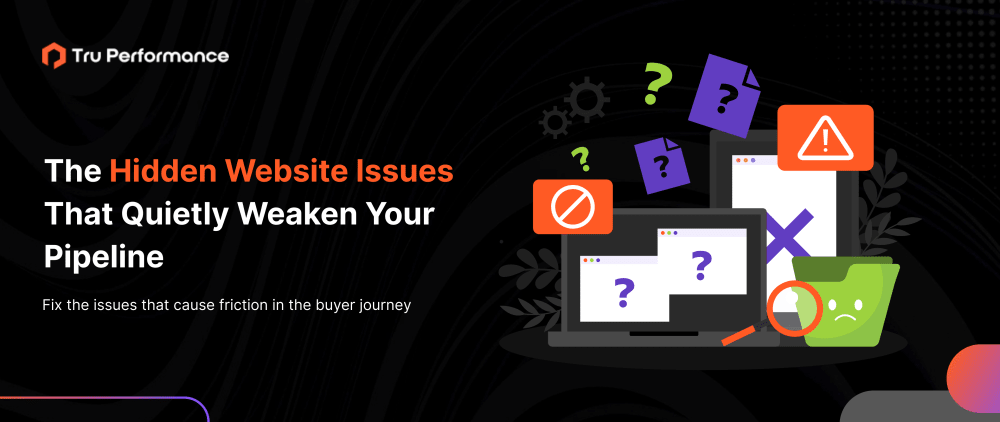
The Hidden Website Issues That Quietly Weaken Your Sales Pipeline

Published January 29, 2026 Blog 4 min read
Listen to this article
4:17
Article summary. Small, often unnoticed website issues introduce friction into the buyer journey, gradually reducing trust, conversions, and pipeline velocity. Buyers abandon sessions not because of lack of interest, but due to broken links, slow pages, confusing navigation, or forms that fail at critical moments. These hidden breakdowns compound over time, making pipeline decline appear like a demand issue when it is actually an experience problem. Common conversion blockers include outdated links, performance issues, inconsistent messaging, and poorly designed user paths. Regular audits, clear journey mapping, aligned messaging, and streamlined forms help remove friction and restore buyer momentum. Treating the website as a revenue system rather than a static asset leads to more predictable conversions, shorter sales cycles, and stronger pipeline health. Introduction Small website issues rarely announce themselves loudly. They do not trigger alerts, crash servers, or stop traffic overnight. Instead, they quietly introduce friction into the buyer journey. Over time, these small breakdowns compound, reducing conversion rates, extending sales cycles, and weakening pipeline velocity. Most B2B teams focus on driving more traffic when pipeline slows. But in many cases, the real issue is not acquisition. It is leakage. Buyers arrive with intent, encounter friction, and leave without converting. This is how website errors silently drain your pipeline. Invisible Breakdowns That Push Buyers Away Most websites do not suffer from a single critical flaw. Instead, they lead prospects through a series of small frustrations that erode trust. Broken links, outdated assets, and dead-end pages signal neglect. Slow-loading pages disrupt momentum. Forms that fail to load or submit correctly block high-intent prospects at the point of action. Individually, these issues seem minor. Collectively, they create an experience that feels unreliable. Buyers may not articulate what went wrong, but they feel it immediately. Each bounce, abandoned session, or incomplete form submission is a clear signal that the journey is not seamless. Internal teams often miss these breakdowns because they navigate the site differently. Prospects, however, encounter them in real time and rarely wait for improvement. How Hidden Errors Quietly Collapse Your Pipeline When these errors accumulate, pipeline performance declines gradually but consistently. Slow-loading routes cause high-intent buyers to abandon before engaging with your value proposition. Missing or malfunctioning forms prevent qualified prospects from reaching sales. Inconsistent messaging confuses decision-makers and interrupts buying momentum. Poor journey mapping pushes users into dead ends instead of guiding them toward action. Over time, this leads to lower conversion rates, longer sales cycles, and missed revenue opportunities that rarely show up clearly in standard reports. Pipeline erosion often looks like a demand problem. In reality, it is an experience problem. The Most Common Conversion Killers Several website issues appear repeatedly across underperforming B2B pipelines: Broken or outdated links that lead to 404 errors Slow-loading pages that reduce buyer intent Forms that fail to load, submit, or capture data accurately Inconsistent or unclear messaging across pages Undefined Navigation paths that confuse or misdirect users Each of these introduces friction at a critical decision point. When combined, they create a journey that discourages action rather than enabling it.   Fixes That Restore Pipeline Performance Fixing pipeline leaks does not require radical redesigns. It requires discipline, consistency, and a clear understanding of buyer behavior. Regular UX and technical audits help uncover hidden issues before they impact performance. Mapping journeys by role, intent, and buying stage ensures each visitor sees relevant information at the right moment. Messaging must align with buyer problems, outcomes, and ROI rather than internal product narratives. Forms should be streamlined to remove unnecessary fields and reduce effort. Page speed and navigation must be optimized across both web and mobile experiences. These fixes do not just improve usability. They restore confidence, clarity, and momentum throughout the buyer journey. Stop the Leaks and Start Converting with Confidence Pipeline health depends on more than traffic and campaigns. It depends on how effectively your website guides buyers from interest to action. When friction is removed, high-intent prospects move faster. Sales conversations start earlier. Conversion rates stabilize, pipeline becomes predictable rather than volatile. The most effective teams treat their website as a revenue system, not a static asset. By identifying hidden errors early and resolving them systematically, they stop leakage and build a foundation for sustainable growth.
TRU_trupdigitalblogbanner1.5_280126_TP110_design_v1

Article Summary

  • Small, often unnoticed website issues introduce friction into the buyer journey, gradually reducing trust, conversions, and pipeline velocity.
  • Buyers abandon sessions not because of lack of interest, but due to broken links, slow pages, confusing navigation, or forms that fail at critical moments.
  • These hidden breakdowns compound over time, making pipeline decline appear like a demand issue when it is actually an experience problem.
  • Common conversion blockers include outdated links, performance issues, inconsistent messaging, and poorly designed user paths.
  • Regular audits, clear journey mapping, aligned messaging, and streamlined forms help remove friction and restore buyer momentum.
  • Treating the website as a revenue system rather than a static asset leads to more predictable conversions, shorter sales cycles, and stronger pipeline health.

Explore AI Summary

Introduction

Small website issues rarely announce themselves loudly. They do not trigger alerts, crash servers, or stop traffic overnight. Instead, they quietly introduce friction into the buyer journey. Over time, these small breakdowns compound, reducing conversion rates, extending sales cycles, and weakening pipeline velocity.

Most B2B teams focus on driving more traffic when pipeline slows. But in many cases, the real issue is not acquisition. It is leakage. Buyers arrive with intent, encounter friction, and leave without converting.

This is how website errors silently drain your pipeline.

Invisible Breakdowns That Push Buyers Away

Most websites do not suffer from a single critical flaw. Instead, they lead prospects through a series of small frustrations that erode trust.

Broken links, outdated assets, and dead-end pages signal neglect. Slow-loading pages disrupt momentum. Forms that fail to load or submit correctly block high-intent prospects at the point of action.

Individually, these issues seem minor. Collectively, they create an experience that feels unreliable. Buyers may not articulate what went wrong, but they feel it immediately. Each bounce, abandoned session, or incomplete form submission is a clear signal that the journey is not seamless.

Internal teams often miss these breakdowns because they navigate the site differently. Prospects, however, encounter them in real time and rarely wait for improvement.

How Hidden Errors Quietly Collapse Your Pipeline

When these errors accumulate, pipeline performance declines gradually but consistently.

Slow-loading routes cause high-intent buyers to abandon before engaging with your value proposition. Missing or malfunctioning forms prevent qualified prospects from reaching sales. Inconsistent messaging confuses decision-makers and interrupts buying momentum.

Poor journey mapping pushes users into dead ends instead of guiding them toward action. Over time, this leads to lower conversion rates, longer sales cycles, and missed revenue opportunities that rarely show up clearly in standard reports.

Pipeline erosion often looks like a demand problem. In reality, it is an experience problem.

The Most Common Conversion Killers

Several website issues appear repeatedly across underperforming B2B pipelines:

  • Broken or outdated links that lead to 404 errors
  • Slow-loading pages that reduce buyer intent
  • Forms that fail to load, submit, or capture data accurately
  • Inconsistent or unclear messaging across pages
  • Undefined Navigation paths that confuse or misdirect users

Each of these introduces friction at a critical decision point. When combined, they create a journey that discourages action rather than enabling it.


Fixes That Restore Pipeline Performance

Fixing pipeline leaks does not require radical redesigns. It requires discipline, consistency, and a clear understanding of buyer behavior.

Regular UX and technical audits help uncover hidden issues before they impact performance. Mapping journeys by role, intent, and buying stage ensures each visitor sees relevant information at the right moment.

Messaging must align with buyer problems, outcomes, and ROI rather than internal product narratives. Forms should be streamlined to remove unnecessary fields and reduce effort. Page speed and navigation must be optimized across both web and mobile experiences.

These fixes do not just improve usability. They restore confidence, clarity, and momentum throughout the buyer journey.

Stop the Leaks and Start Converting with Confidence

Pipeline health depends on more than traffic and campaigns. It depends on how effectively your website guides buyers from interest to action.

When friction is removed, high-intent prospects move faster. Sales conversations start earlier. Conversion rates stabilize, pipeline becomes predictable rather than volatile.

The most effective teams treat their website as a revenue system, not a static asset. By identifying hidden errors early and resolving them systematically, they stop leakage and build a foundation for sustainable growth.

Frequently Asked Questions

Everything you need to know about the Issues that can Impact your Website Sales Pipeline

Because websites often serve as the first and most consistent touchpoint for buyers. Friction at this stage reduces trust and prevents prospects from taking action.

Yes. Even small disruptions signal unreliability and cause high-intent buyers to abandon sessions quickly.

At minimum, quarterly audits are recommended, with ongoing monitoring for performance, forms, and navigation paths.

Poorly designed buyer journeys that do not align messaging, intent, and next steps effectively.

Insights from experts driving results on the ground

SEO Agency vs In-House Team: How Growth-Stage SaaS Should Actually Decide
17 min read

SEO Agency vs In-House Team: How Growth-Stage SaaS Should Actually Decide

Your board asked why organic is flat. You have a plan, a keyword set and three technical fixes that have been written up twice....
Read more
Building a B2B Attribution Model Your CFO Will Trust
13 min read

Building a B2B Attribution Model Your CFO Will Trust

Your attribution report says marketing sourced $4.2M in pipeline last quarter. Finance’s report says marketing sourced $1.6M. Both numbers were...
Read more
AI Marketing Ops vs. Traditional Ops: What Actually Changes
8 min read

AI Marketing Ops vs. Traditional Ops: What Actually Changes

The category confusion The phrase “AI marketing ops” has gotten loose in 2026. Vendors use it to describe any marketing...
Read more
What to Look for in an AI Marketing Operations Partner
8 min read

What to Look for in an AI Marketing Operations Partner

Why this evaluation matters more in 2026 Choosing the wrong AI marketing ops partner in 2026 doesn’t just waste a...
Read more
Explore resources