What are Visibility Analytics in Search?
In search optimization, visibility analytics refers to data that shows how easily a website can be discovered on digital platforms used for finding information, such as search engines and AI-driven assistants.
These metrics can help marketers understand how changes in search trends and behavior are causing changes in the way a website receives traffic from different types of search results.
The launch of AI platforms has completely changed the way people do their searches on the internet. This change in search behavior has caused a major change in how search engines display results compared to conventional SERPs.
Content is increasingly viewed in two main buckets: short-form and long-form. How well each type performs on your website now depends on how effectively it’s optimized to be easily read, reused, and published across the platforms that rely on LLMs to answer user queries. This isn’t a distant prediction—it’s already happening, as recent research clearly shows.
- As per a report from Ahrefs’ only 0.5% of the users on the Ahrefs’ website came from AI search and resulted in over 12% of the signups, which was 23 times higher than their normal conversion rate.
- More than 60% of the Millennials and Gen Z already use AI search engines which are more readily available to them through devices of different categories including voice search. As per SparkToro the organic link, clicks declined and zero click searches increased by 3% from 2024 to 2025.
For business owners who still find digital marketing concepts confusing, this shift in AI-powered search creates a clear choice: adapt to the changing landscape or lose visibility to competitors who do. Answer Engine Optimization (AEO) and Generative Engine Optimization (GEO) are two key disciplines designed to address this challenge.
This guide explains how AEO differs from traditional SEO, outlines the latest AEO trends shaping 2025 – 2026, and shows how to use visibility analytics to prioritize strategies that drive real business results.
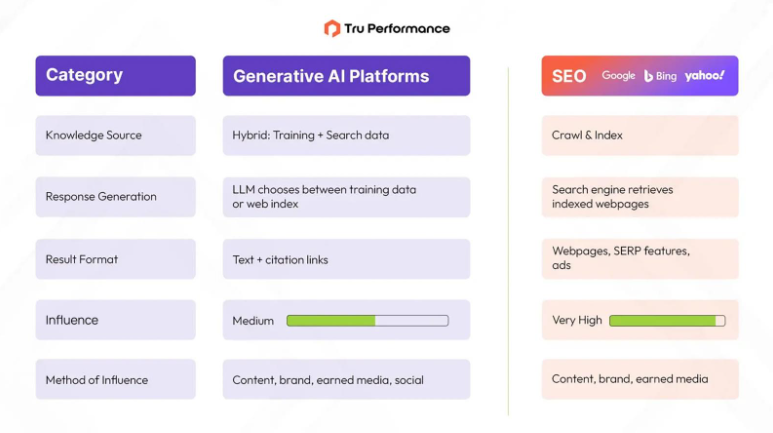
Why Visibility Analytics Matter
With AI engines now scanning billions of pages, guessing which queries to optimize is a waste of time. Visibility analytics tools remove the guesswork by showing where your brand is fully cited, where it’s only partially visible, and where it doesn’t appear at all.
These tools analyze AI-generated answers and surface key metrics such as:
- AI mentions & citations – How often AI platforms reference your brand or content.
- Question coverage – How many relevant user questions your content successfully answers across different platforms.
- AI visibility score – A combined metric that reflects your share of voice across multiple AI engines (often provided by platforms like Profound or Surfer).
- Referral traffic & conversions – How much traffic, lead volume, and revenue are being driven by AI citations—even small numbers here can indicate highly qualified, high-value leads.
Trends Shaping AEO in 2026
While Answer engines are evolving continuously, it’s important for every business owner and marketing teams to keep itself updated with developments:
LLM Optimization and Hyper-Personalization
AI platforms like ChatGPT, Claude, Perplexity, and Gemini all rely on large language models (LLMs) to generate in-depth, long-form answers. These responses are more descriptive than traditional search snippets and are usually triggered by longer, natural-language queries—what we now call prompts. As users get more comfortable “asking AI” instead of “Googling it,” these tools are quickly becoming powerful discovery platforms, not just helpers.
To keep up, your website’s content needs to be structured in a way that matches how these systems retrieve and interpret information. That means writing with the deeper context of user queries in mind, not just keywords, so AI can understand, segment, and reuse your content accurately.
A core concept here is the “Query Fanning Technique.” In AI search, a single user question is often broken into multiple sub-topics. The system then looks for answers to each of those sub-questions and recombines them into one comprehensive, long-form response.
The SEO community has started mirroring this with a practice often called “Query Fanning Analysis.” Instead of looking only at individual keywords, SEOs use AI to break primary queries into smaller, related sub-queries, cluster them, and then create long-form content that addresses each of those angles in one place. This approach blends traditional keyword research and clustering with AI-driven query analysis, making your content far more attractive & personalized to modern answer engines.
Local & Multi‑Platform Considerations
One thing many business owners don’t realize: Google’s AI Mode loves local results. It can show location-based businesses even when the search doesn’t sound local at all. If your Google Business Profile isn’t in great shape (think: accurate address and hours, strong visuals, real customer reviews), AI Mode may promote another local listing instead of your site.
On top of that, every AI assistant has their own “taste”. ChatGPT, Perplexity, Bing Copilot and others, all weigh different sources. So modern AEO isn’t just “rank in Google and you’re done”, it’s about making sure your brand shows up, looks credible, and stays consistent wherever people ask their questions.
ROI Measurement & Continuous Auditing
As AI results get more crowded and competitors battle for the same answer slots, marketers are no longer satisfied with traditional SEO metrics—they’re asking for fresh benchmarks that show whether their brand is actually winning in AI search.
Tools like SEMrush have updated their reporting dashboards to include the new metrics like AI citations & Brand mentions which are two of the most common forms of AI results visible today on LLMs and AI overviews.
Structured Content & Topic Clusters
AI platforms tend to favor structured data above other formats. Because it’s already organized and machine-readable, these systems can query, interpret, and reuse the information much faster and more reliably.
Types of AI Results Format on SERP
| Category | What It Is | Why It Helps AI | Where It’s Used |
| Semantic HTML structure | Clean, well-structured HTML using semantic tags and clear hierarchy | Helps LLMs and crawlers identify topics, sections, lists, steps, and comparisons | Page templates for blogs, landing pages, docs; used to structure headings, content blocks, lists, tables, FAQs |
| JSON-LD structured data | Google-recommended schema format embedded as JSON | Gives machines explicit labels for entities, questions, answers, and products | script type="application/ld+json" in or ; managed via CMS, plugins, or dev implementation |
| Microdata / RDFa | Inline schema attributes attached to HTML elements | Converts specific pieces of content into structured entities that crawlers can map | Added directly to HTML tags around titles, prices, ratings, authors, etc. |
| Entity & knowledge-graph markup | Structured representation of brands, people, and locations | Helps AI engines connect your site to stable entities in their knowledge graphs | On About/Contact/Location pages; links to LinkedIn, Wikipedia, GBP, and other authoritative profiles |
| Open Graph & social metadata | Meta tags that define how content appears when shared | Provides compact, high-quality summaries and canonical URLs that LLMs can reuse | In the of each page; typically added by SEO or social plugins |
| XML sitemaps | Machine-readable map of your site’s URLs and last-modified dates | Improves discovery and crawl coverage, helping AI-influenced systems see more of your content | Generated by CMS/SEO tools; submitted to Google Search Console and used by other crawlers |
| RSS / Atom feeds | XML feeds listing recent content in a structured, chronological format | Offers a clean stream of fresh content that aggregators and some AI pipelines can ingest | Usually auto-generated by CMS (e.g., /feed, /rss); consumed by readers, apps, and syndication services |
| Media metadata (images & video) | Textual and structured descriptors for visual and rich media | Helps AI understand what images and videos represent and when to surface them in answers | alt attributes, file names, transcripts, and schema for product images, explainer videos, thumbnails, etc. |
| Local business data | Structured profile of locations, NAP, reviews, photos | Critical for AI modes that prefer local listings over direct website links | Google Business Profile dashboard + mirrored on site with consistent NAP and local schema |
| API / data-feed formats (advanced) | Machine-readable endpoints or files exposing structured business data | Allows external systems and future AI integrations to consume clean product, pricing, or content | Provided via documented APIs or feeds; used by marketplaces, comparison engines, and potential AI partners |
| LLM-friendly content patterns | Human-readable but highly regular patterns within HTML content | Makes it easy for LLMs to extract direct answers, steps, and comparisons for zero-click results | Implemented directly in on-page copy: FAQ sections, “What is…?” definitions, numbered steps, comparison tables |
TOON as a Token-Efficient Alternative to JSON
Up to now, most structured data on the web has been packaged in JSON. It’s flexible and developer-friendly, but it’s also noisy: every brace, quote, and comma cost token when that data is sent into an AI model. For AI systems that read everything as tokens, that “syntax overhead” turns into higher costs and slower responses.
That’s where TOON (Token-Oriented Object Notation) comes in. TOON keeps the same underlying structure as JSON—objects, arrays, and fields—but rewrites it in a much more compact, table-like format that’s easier for language models to digest. Instead of repeating keys and punctuation repeatedly, TOON declares the structure once and then lists the data in simple rows. In many real-world tests, this cuts token usage by roughly 30–60% for uniform datasets.
You can think of it like this:
- JSON was designed for people and APIs to exchange data.
- TOON is JSON’s “AI-native” cousin, same meaning, lighter wrapper, fewer tokens.
For business owners, the important takeaway isn’t that you need to start writing TOON by hand. Instead, AEO and visibility tools can use formats like TOON behind the scenes to send larger, richer datasets into LLMs—logs of questions, visibility metrics, citation patterns—without blowing up cost or latency. That means smarter insights, more precise AI-driven recommendations, and faster experimentation with the same (or lower) budget.
In other words: as AI search becomes more data-hungry, formats like TOON help your tools feed models more context, more efficiently. You still focus on strategy and content; the infrastructure quietly upgrades how that data is packaged for AI.
Challenges & Considerations
Even with strong potential, AEO comes with a few real-world hurdles business owners should understand:
Constant change
AI models evolve quickly, and updates can subtly change how they read, rank, and reuse your content. You can’t “set and forget” AEO—regular checks and adjustments are part of the game.
Many platforms to manage
You’re no longer optimizing for just one search engine. Modern AEO means thinking about how your brand appears across multiple assistants and answer engines (from chatbots to AI overviews), each with its own quirks.
Immature analytics
Most standard analytics tools don’t clearly separate AI-driven exposure from classic organic search. Dedicated tracking solutions are still developing, which can make measuring AI visibility feel fuzzy at first.
Skills and bandwidth
Effective AEO are not just “adding a few FAQs.” It often requires subject-matter experts, people comfortable with structured data and schema, and coordination between SEO, content, and dev teams. Many businesses lean on agencies or specialized partners to bridge those gaps.
Data protection and compliance
As you feed more data into AI tools and visibility platforms, you need to stay on top of privacy laws and internal data policies. Any AEO or analytics setup should be designed with consent, security, and compliance in mind from day one.
Action Plan to Achieve AI Search Visibility
AI‑driven search is reshaping the digital landscape at an unprecedented pace. As user behavior shifts toward direct answers and voice interactions, Answer Engine Optimization (AEO) becomes indispensable. Visibility analytics provide the compass: they tell you where you stand, reveal quick wins and guide content and technical improvements.
To stay ahead:
- Benchmark your current AI visibility using specialized tools.
- Identify the questions your audience asks and create structured, concise answers with clear headings and schema.
- Strengthen authority by demonstrating expertise, refreshing content, and maintaining accurate local listings.
- Continually monitor AI citations and adjust strategies as models evolve.
Adopting these practices now will protect and enhance your visibility in AI‑powered search, driving high‑intent traffic and conversions long after traditional click‑based SEO begins to fade.






 Article Summary