9 min read
 Article Summary
Article Summary- AI and automation are revolutionizing outsourcing, improving efficiency and reducing costs in a shift known as Outsourcing 2.0
- RPA automates repetitive tasks, while AI uses self-learning systems to enhance decision-making and process optimization.
- AI and automation bring strategic benefits like improved labor efficiency, better security, and streamlined processes.
- The shift from labor arbitrage to automation is reducing low-level jobs while creating opportunities for higher-end roles.
- Businesses must reskill their workforce, address data privacy, and update contracts to integrate AI and automation effectively.
Introduction
Outsourcing is usually seen as a critical choice for businesses aiming to secure specialized talent as a cost-effective solution. Traditionally, global hubs in the southern hemisphere, such as India, Brazil, and the Philippines, established themselves by offering a comprehensive range of business operations at reduced costs. However, a real change is now sweeping across this industry. As technology rapidly advances, Artificial Intelligence (AI) and automation are actively creating a disruption in the outsourcing industry. This particular transformation is so significant that it is often referred to as “Outsourcing 2.0,” redefining how companies manage tasks, streamline operations, and achieve unprecedented efficiency.
Intelligent Automation, which encompasses both Robotic Process Automation (RPA) and AI, is transforming the outsourcing industry in many different ways. This shift is expected to dramatically reduce costs, increase capability, and help buyers achieve the Triple-A Trifecta of Automation, Analytics, and Artificial Intelligence. This article explores the impact of these technologies, examining their mechanics, strategic benefits, and the necessary adjustments required to navigate this transformation.
The Mechanics of Transformation: Defining RPA and AI in Operations
The transition to Outsourcing 2.0 is acted upon by two distinct, yet interconnected technologies: Robotic Process Automation (RPA) and Artificial Intelligence (AI). While both fall under the umbrella of Intelligent Automation, understanding their unique roles is quite important.
Defining the Digital Workforce
Robotic Process Automation (RPA)
RPA is the current “it” automation technology, dominating activities focused on improving process efficiency. It is categorized as a programmable software tool that helps businesses to customize complex automations. The primary use of RPA is to reduce the human labor required in many repetitive, rule-based actions and processes. In current practice, many service partners and enterprises are focused on RPA initiatives, with significant depth emerging in areas like contact center projects and Finance & Accounting (F&A). However, much of the current utilization is focused on cost savings, especially removing labor from processes, which are often with little or no process redesign. Its full potential is realized when integrated with end-to-end process redesign.
Artificial Intelligence (AI)
AI represents the simulation of human thought processes across enterprise operations. Unlike RPA, AI systems are trained, not programmed. AI involves self-learning systems that utilize natural-language processing (NLP), data mining, and pattern recognition to mimic how the human brain functions, all without requiring continuous manual intervention.
AI systems are designed to make decisions on their own using high-level policies, constantly monitoring and optimizing performance, and automatically adapting to business rules, dynamics, and changing conditions. AI holds the potential to solve business problems by fundamentally changing or reimagining processes. AI possesses broader long-term potential than RPA and will ultimately have a much larger effect on the outsourcing market, despite currently being in a more nascent stage.
Automation’s Impact on Processes
AI’s role in outsourcing is centered on two key areas: automating repetitive tasks and improving high-level decision-making.
- Automating Repetitive Tasks: AI’s ability to handle rule-based and repetitive tasks with unmatched accuracy and speed is one of its most significant contributions. Traditionally outsourced manual tasks like data entry, IT support, and customer service can now be performed more efficiently by AI-powered systems. For example, virtual assistants and AI-powered chatbots can manage customer inquiries 24 hours a day, seven days a week, which significantly reduces response times and frees human employees to concentrate on more intricate tasks. Estimates from McKinsey suggest that AI systems could automate up to 60–70% of tasks that currently consume employees’ time.
- Improving Data Analysis and Decision-Making: AI’s capacity to rapidly analyze massive data volumes is invaluable across outsourced functions in fields like finance, healthcare, and market research. By leveraging machine learning algorithms, outsourcing partners can deliver clients much deeper insights into consumer behavior, operational inefficiencies, and market trends. In the financial sector, AI can analyze market patterns to support more informed investment decisions. Meanwhile, in outsourced manufacturing operations, predictive analytics can anticipate equipment failures. This helps in reducing downtime and improve maintenance processes.
Strategic Benefits and the Changing Workforce Dynamic
The integration of AI and automation offers numerous tangible benefits that extend far beyond simple labor cost reduction, driving high value for client organizations and their outsourcing partners.
The Difference: Traditional vs Automated-Driven Outsourcing Model
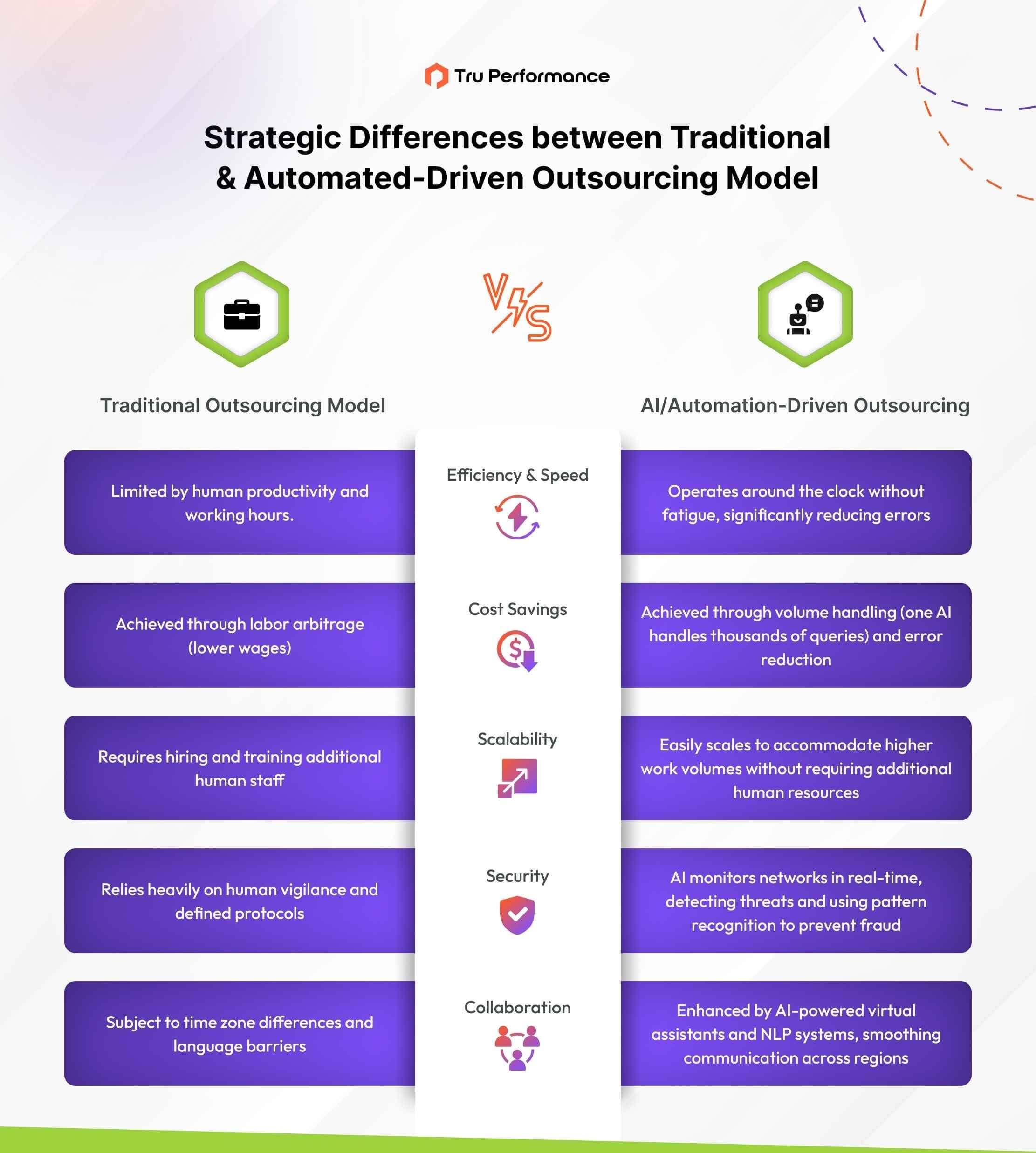
Cybersecurity is a major concern when sensitive data is outsourced. AI-powered security systems are crucial, as they can monitor networks, detect threats, and immediately respond to potential breaches in real-time. Furthermore, pattern recognition capabilities are leveraged to identify and prevent fraudulent activities in financial transactions. Outsourcing firms that utilize AI to enhance security not only safeguard valuable data but also establish more reliable and trustworthy client relationships.
AI also plays a pivotal role in outsourcing management. It simplifies the complex task of vendor selection by analyzing historical data concerning vendor performance, quality of work, and delivery schedules.
Adding to that, AI automates contract management functions by monitoring compliance, tracking deadlines, and proactively identifying risks, which reduces the likelihood of disputes.
Real-time analytics supplied by AI allows businesses to monitor Key Performance Indicators (KPIs) such as customer satisfaction scores and task completion times, making sure that issues are addressed immediately.
The Evolution of Labor Arbitrage
Intelligent automation is fundamentally changing labor arbitrage-based outsourcing models. Growth rates for offshore outsourcing have been steadily decreasing, signaling that labor arbitrage is a fading business model.
While AI and RPA are causing the decline of low-level, manual jobs, particularly in traditional offshore locations like the Philippines and India, the situation also presents an opportunity for job creation. New, higher-end roles are emerging, focusing on tasks such as auditing, bot management, programming bots, digital process development, and handling exceptions identified by the automated systems. The per-transaction savings driven by automation may be so substantial that they could result in net job growth by attracting significantly more work to outsourcing providers.
In terms of adoption maturity, A recent state of automation study indicated that four-fifths of enterprise buyer respondents are in either stage one (Investigate) or stage two (Implement) of the Intelligent Automation Maturity Model. Initiatives in these stages are generally focused on initial cost savings by removing people from processes or improving process effectiveness, rather than redesigning the whole process.
Navigating the New Landscape: Challenges and Contractual Shifts
The adoption of AI in outsourcing, while transformative, is accompanied by specific challenges that organizations must proactively address, particularly concerning workforce upskilling and contractual practices.
Critical Challenges and Considerations
- Workforce Reskilling: A major challenge is the need to reskill the workforce. As automation takes over tasks, employees must be trained to collaborate with AI technologies. The focus must shift toward higher value-added activities, such as creative problem-solving and strategy development. Essential change management practices are required to maintain a positive company culture and reduce the negative impact on staff morale.
- Data Privacy and Security Risks: Outsourcing involves sharing sensitive data, and AI systems introduce new risks, including model inaccuracies and algorithmic bias. Companies must implement strong governance frameworks to oversee AI processes and make sure that data privacy regulations are followed. The risk of a hacked RPA or AI software instance is severe, as it can operate much faster and access far more data than an employee who has leaked it.
- Data Protection in Shared AI: A critical choice arises regarding data usage: putting data into AI systems shared across multiple companies provides greater overall insight for the AI, but simultaneously transfers the value of that data to the provider and other customers. Choosing a dedicated instance of the AI protects the customer’s data but results in a less insightful AI. This decision is critical because once data is used by a shared AI, there may be no way to remove the customer’s contribution from what the shared AI has learned.
Updating Outsourcing Contracts for Digital Labor
The introduction of Intelligent Automation necessitates a fundamental change in how outsourcing engagements are managed and crafted. Traditional outsourcing agreements were designed with the assumption that all work would be performed by people, relying on clauses such as “adequate numbers of appropriately trained and experienced personnel”. But now, contracts have to be drafted in such a way that both digital and human labor are accounted for.
These are the eight developed recommendations for incorporating Intelligent Automation into outsourcing agreements:
| Rommendation Focus Area | Key Actions for Outsourcing Contracts |
|---|---|
| Existing Contracts | Be proactive; discuss the provider's use of intelligent automation, the impact on cost/profit, and opportunities to share realized efficiencies. If automation is not used, request a strategy update. |
| New Contract Selection | Include intelligent automation capabilities (RPA/AI) as a critical criterion in provider evaluation and selection. Design the outsourced process specifically around the effective use of these technologies. |
| Realistic Expectations | Beware of hype; be specific about stated benefits. Challenge inflated reductions, understanding that sub-process automation (e.g., 40% reduction in one step) may translate to a much smaller overall scope of benefit (e.g., 8%). |
| Contract Structure (Human/Digital Mix) | Include clauses for: visibility and approval of RPA/AI use; obligations for AI implementations to meet defined specifications, IP rights for work generated by bots, process validation, and inclusion of change management clauses. |
| Reimagining Service Commitments | State exactly which tasks are performed by humans and which ones by the bots. Replace human-centric service levels (e.g., average hold time) with digital-centric service levels (e.g., exceptional processing time). |
| Addressing Data Risks | Add cybersecurity and data privacy clauses directed specifically at RPA/AI software risks. Review contracts carefully to prevent the digital service provider from using customer data or derived insights without permission. |
| Repricing and Incentives | Reprice to share gains. Pricing recommendations include moving from input-based (FTEs) to output-based (transactions processed) or outcome-based measures; requiring cost reduction commitments; and utilizing gainsharing based on a firm baseline. |
| Reviewing Related Contracts | Check cloud-based or subscription services, as they may prohibit use via bots or impose unexpectedly large charges (e.g., treating one bot’s use as the equivalent of use by every human who works through it). |
Future Trends: The Evolution of Outsourcing 2.0
Businesses continue to integrate AI strategically into their outsourcing frameworks. Some of the many trends that are set to further reshape the landscape are listed below.
AI-Driven Robotic Process Automation (RPA)
The sophistication of RPA is growing. AI is being used to handle increasingly complex tasks that were traditionally performed by employees. This includes managing supply chains and processing invoices. This evolution is expected to drive better productivity across the board and reduce the costs at the same time.
Virtual Teams Powered by AI
The future points toward AI-powered virtual teams. In these models, AI systems and human employees collaborate by providing clients with the best combination of capabilities: the computational efficiency and power of AI coupled with the emotional intelligence and creativity of human thought.
Conclusion
AI and automation are not just small improvements; they are evolving in a new, profound era of outsourcing. From faster decision-making and better security to increasing operational efficiency and facilitating collaboration, the impact of AI is undeniable. For outsourcing providers, this is a decisive moment: they must aggressively embrace RPA and AI or face disruption in a market where labor requirement is fading.
The transition to intelligent automation can be viewed metaphorically as moving from using specialized teams (human outsourcing teams) to using highly complex, yet massively scalable, assembly lines (AI and RPA). While the specialists were skilled, the new assembly lines can run 24/7, handle vast volumes, and improve their efficiency automatically, essentially changing the economics and possibilities of global production.